

23 Books That Will Transform Your Life
A journey through literature, philosophy, science and ideas
Introduction
Some books entertain us; others change the way we understand ourselves and the world. A powerful book can introduce an unfamiliar idea, challenge an assumption, deepen our empathy or help us see a familiar subject from a new perspective. The most influential reading experiences do not always provide easy answers. Often, they leave us with better questions.
This selection brings together 23 works from literature, philosophy, politics, history, science and personal development. They differ greatly in style and difficulty: some are novels that illuminate human relationships, while others are demanding arguments or landmark works that helped shape public debate. They are not all self-help books, nor will every title suit every reader. Their shared value is the opportunity they offer to think more critically, understand different experiences and explore ideas that have influenced the modern world.
The order in which the books appear is entirely arbitrary and should not be understood as a ranking or comparison. A book listed first is not necessarily better, more influential or more popular than one listed tenth—or vice versa. The sequence is simply a way of organising the article, not a judgement about the relative value or importance of any title.
The purpose of presenting these books is not to suggest that they are perfect or that every point they make is entirely correct. Rather, the aim is to open a window onto different ways of thinking about particular subjects, introduce ideas that may challenge or broaden our perspectives, and explore how these works were received by readers and the wider public when they first appeared. Their value lies not in asking us to accept everything they say, but in giving us the opportunity to consider their arguments, question their assumptions and understand the influence they have had.
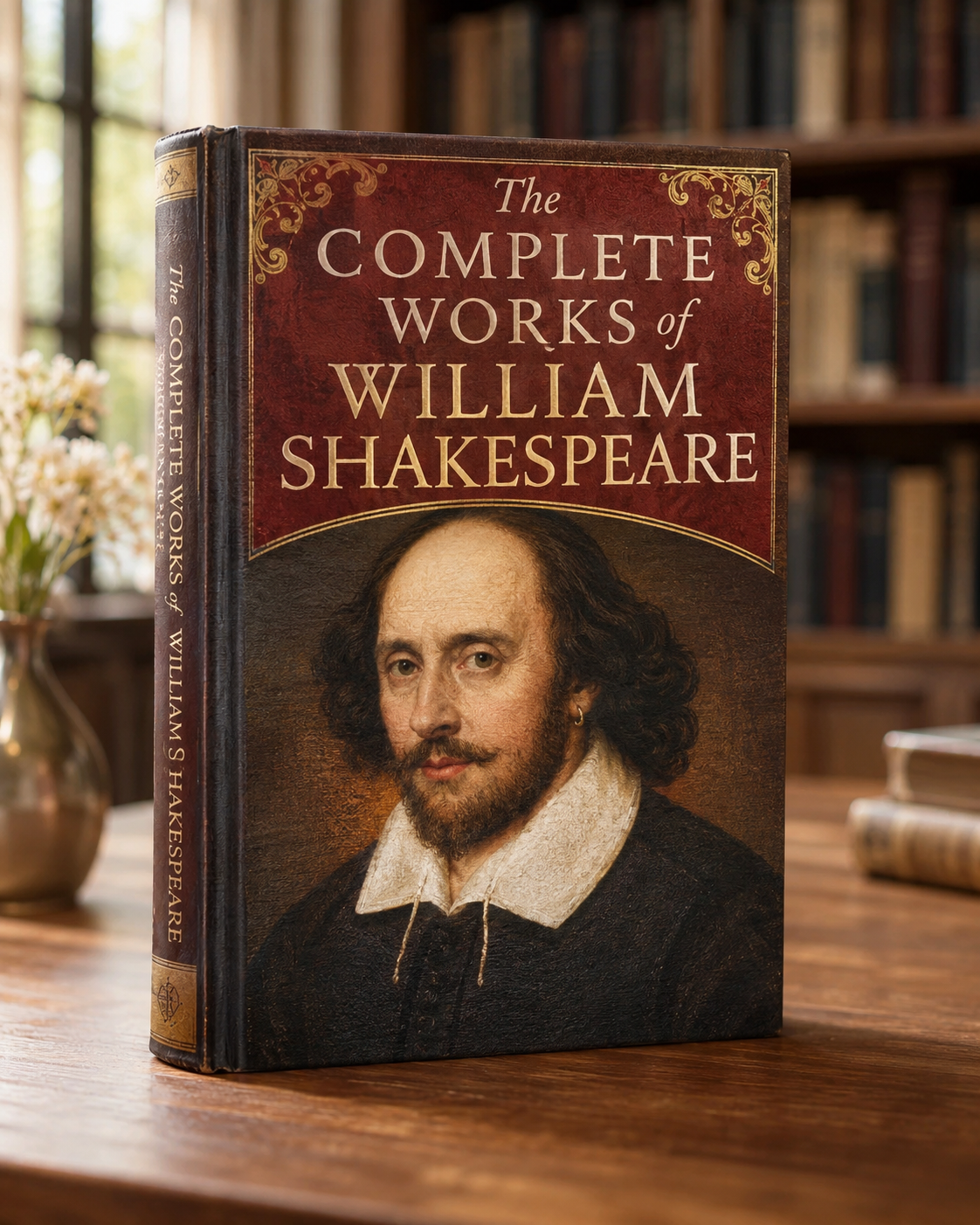
1. The Complete Works of William Shakespeare
By William Shakespeare
Rather than a single volume, Shakespeare’s complete works are published in collections that bring together plays and poetry, including tragedies, comedies, histories, romances and sonnets. Across these works, Shakespeare examines love, jealousy, ambition, betrayal, loyalty, revenge, justice, identity and the exercise of political power. His characters often struggle with the difference between appearance and reality, the demands of family and society, and the consequences of their choices. The plays also explore questions of authority, succession, morality and human weakness. Because the collection is extensive and its language can be challenging, new readers may find it easier to begin with an accessible play—such as Macbeth, Romeo and Juliet or Much Ado About Nothing—before exploring a larger edition.
Inside the Book
Structure note: Shakespeare’s complete works are not arranged as one continuous book and therefore have no single chapter count. A common modern collection presents the plays separately, each divided into acts and scenes, alongside poems and 154 sonnets. The generally accepted play count is often given as 38, but the inclusion and attribution of collaborative or disputed works—such as Edward III and Sir Thomas More—varies by edition; Cardenio is lost.
Comedies and romances — The Comedy of Errors: Two sets of identical twins create mistaken identities and escalating confusion in Ephesus.
The Two Gentlemen of Verona: Friendship and loyalty are tested when two friends fall in love with the same woman.
The Taming of the Shrew: A courtship plot examines marriage, gender expectations and power through comic conflict.
Love’s Labour’s Lost: A group of men vow to avoid romance, only to have their resolve challenged by the arrival of women.
A Midsummer Night’s Dream: Four young lovers, amateur actors and fairies become entangled in a magical forest.
The Merchant of Venice: A bond between a merchant and a moneylender leads to a courtroom dispute about law, mercy and prejudice.
Much Ado About Nothing: Romantic misunderstandings, deception and a false accusation test two couples.
The Merry Wives of Windsor: Two married women outwit Falstaff after he attempts to court them for financial advantage.
As You Like It: Disguises and exile in the Forest of Arden create opportunities to reconsider love, identity and social roles.
Twelfth Night: Shipwreck, disguise and mistaken identity produce a comic tangle of affection and ambition.
All’s Well That Ends Well: Helena pursues Bertram despite his resistance, raising questions about desire, status and consent.
Measure for Measure: A deputy enforces strict moral laws, while the play tests justice, hypocrisy and mercy.
The Winter’s Tale: Jealousy destroys a family before time, repentance and reconciliation offer the possibility of renewal.
The Tempest: A magician uses a remote island to confront betrayal and ultimately considers forgiveness and release.
The Two Noble Kinsmen: Two friends become rivals in love; the play is generally regarded as a collaboration between Shakespeare and John Fletcher.
Histories — King John: Political legitimacy, succession and national loyalty shape a conflict over the English crown.
Richard II: The deposition of a king explores divine right, political responsibility and the instability of authority.
Henry IV, Part 1: Prince Hal’s relationship with Falstaff contrasts youthful disorder with the demands of kingship.
Henry IV, Part 2: Political unrest continues as Hal moves closer to the responsibilities of rule.
Henry V: The king leads a campaign in France, and the play examines leadership, war and national identity.
Henry VI, Part 1: The loss of French territories and factional conflict expose weaknesses in English leadership.
Henry VI, Part 2: Rival nobles struggle for influence as rebellion and political instability grow.
Henry VI, Part 3: The Wars of the Roses intensify as competing claims to the throne produce further violence.
Richard III: Richard manipulates and murders his way towards the crown, revealing the destructive ambition of tyranny.
Henry VIII: Court politics, royal marriage and the fall of powerful figures shape this late history play, commonly understood as collaborative.
Tragedies — Titus Andronicus: A Roman general’s family is drawn into a cycle of revenge, cruelty and political violence.
Romeo and Juliet: Two young lovers are caught between their families’ feud and their desire to be together.
Julius Caesar: The assassination of Caesar leads to political conflict and questions about ambition, honour and public duty.
Hamlet: A prince investigates his father’s murder while wrestling with grief, revenge, uncertainty and action.
Othello: Manipulation and jealousy destroy the trust between Othello and Desdemona.
King Lear: A king’s division of his kingdom exposes family betrayal, pride, suffering and the limits of authority.
Macbeth: A prophecy and unchecked ambition lead Macbeth and Lady Macbeth into murder, tyranny and psychological collapse.
Antony and Cleopatra: The relationship between a Roman leader and Egypt’s queen becomes entangled with imperial power and political loyalty.
Coriolanus: A celebrated soldier’s contempt for the people and political compromise brings about his downfall.
Timon of Athens: A generous man’s experience of betrayal turns him against the society that once celebrated him.
Cymbeline: A royal family is divided by deception, jealousy and exile before a series of recognitions restores the possibility of reconciliation.
Pericles, Prince of Tyre: Pericles faces shipwreck, separation and loss across the Mediterranean before his family is reunited; parts of the play are generally attributed to a collaborator.
Troilus and Cressida: Set during the Trojan War, the play examines love, honour, reputation and the disillusionment of war.
Poetry and sonnets: The sonnets explore love, beauty, time, jealousy, friendship and mortality; longer poems such as Venus and Adonis and The Rape of Lucrece tell extended narrative stories.
Why it matters: Shakespeare offers an enduring study of human motives, relationships and power, while introducing readers to a foundational voice in English-language literature.
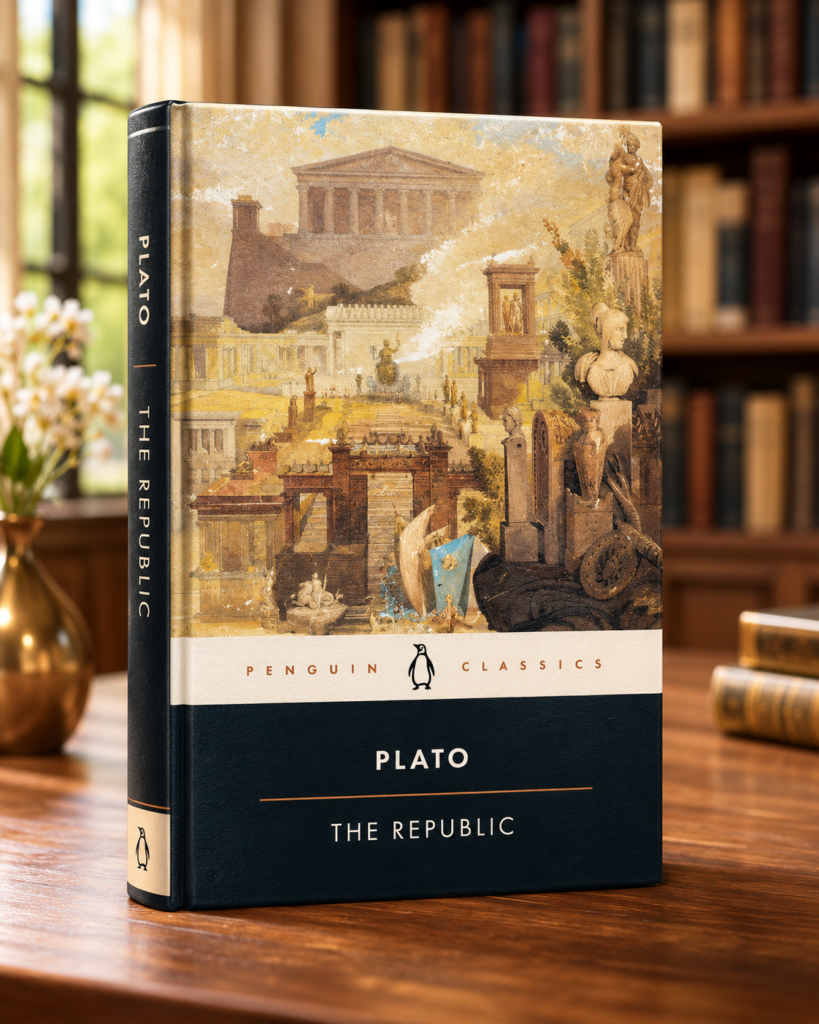
2. The Republic
By Plato
Written as a philosophical dialogue led by Socrates, Plato’s The Republic asks what justice is and whether a just life is better than an unjust one. The discussion moves between the individual and the state: Plato considers how a well-ordered society might be organised, the education and responsibilities of its rulers, and the relationship between political authority and knowledge. He develops an account of the soul with rational, spirited and appetitive elements, and argues that justice involves these parts performing their proper roles. The work is also known for the idea of the philosopher-ruler, the theory of Forms, the Form of the Good and the allegory of the cave, which explores the difference between appearance and understanding. Later books consider the decline of political systems, including democracy and tyranny, as well as the fate of the soul. Plato’s political proposals remain influential but are also contested and should be read as philosophical arguments rather than universally accepted prescriptions.
Inside the Book
Book I: Socrates tests definitions of justice offered by Cephalus, Polemarchus and Thrasymachus, exposing the weaknesses in conventional ideas about honesty, helping friends and serving the stronger.
Book II: Glaucon and Adeimantus challenge Socrates to show that justice is valuable in itself; the discussion begins constructing a city and considers the education of its guardians.
Book III: Socrates sets out rules for poetry, music, physical training and the selection of guardians, arguing that education shapes character and civic responsibility.
Book IV: The ideal city’s virtues are identified, and Socrates compares its order with the individual soul, whose rational, spirited and appetitive parts must be properly balanced.
Book V: The dialogue introduces the controversial proposals that women may serve as guardians, that guardians share family arrangements, and that philosophers should rule.
Book VI: Socrates explains the nature of the philosopher and the Form of the Good, using the images of the sun and the divided line to distinguish knowledge from opinion.
Book VII: The allegory of the cave illustrates the movement from illusion to understanding; the education and training required of future rulers are then described.
Book VIII: Socrates traces the decline from the ideal aristocratic city through timocracy, oligarchy and democracy to tyranny, linking political systems with types of character.
Book IX: The tyrannical person is examined as ruled by lawless desires, and Socrates argues that the just life is happier than the unjust one.
Book X: Socrates renews the criticism of imitative poetry, discusses the soul’s immortality and closes with the Myth of Er, which considers the consequences of moral choice.
Why it matters: It encourages readers to examine justice both within themselves and in society, and to question how education, knowledge and political leadership shape public life.
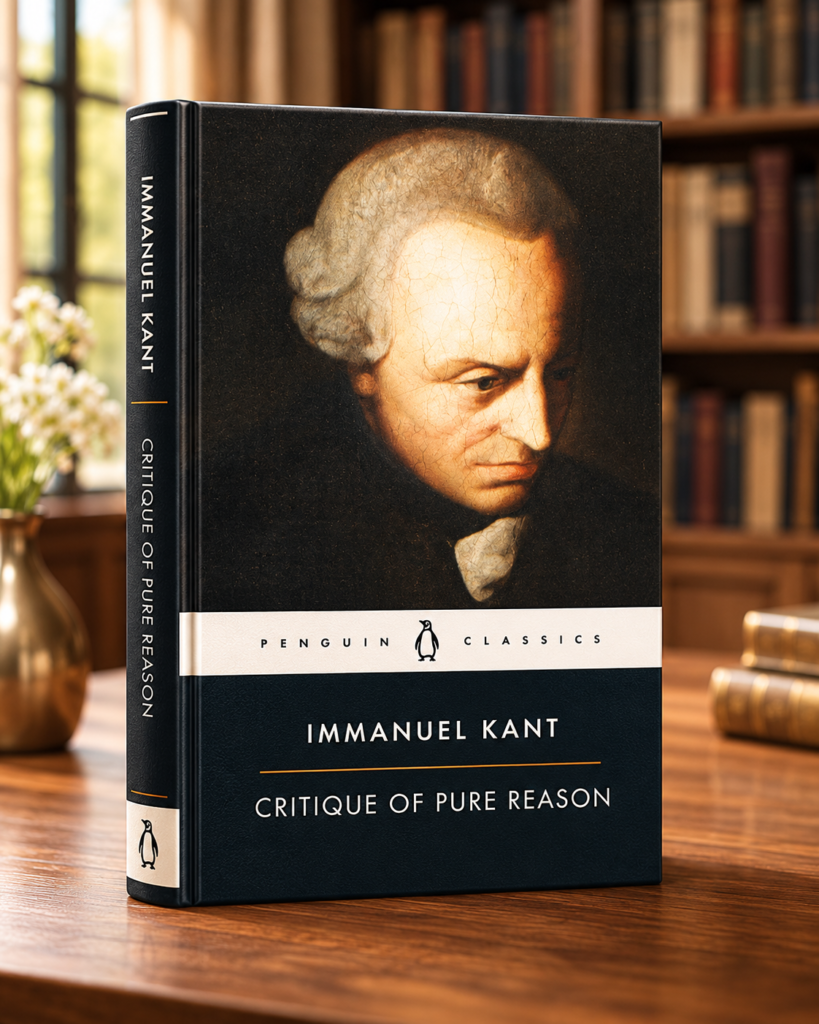
3. Critique of Pure Reason
By Immanuel Kant
In this demanding work, Immanuel Kant investigates how human knowledge is possible and where its limits lie. He asks what the mind contributes to experience, how knowledge can be both informative and necessary, and whether reason can establish claims about subjects beyond possible experience. Kant argues that space and time are forms through which human beings experience the world, while the mind organises experience through basic concepts or categories of understanding. He also examines why reason encounters difficulties when it tries to prove claims about the soul, the universe as a whole or God. The book addresses the foundations of mathematics and natural science as well as the possibilities and limits of metaphysics. Its arguments reshaped modern epistemology and metaphysics, challenging both straightforward empiricism and traditional rationalist approaches. The original work is not an easy introduction to philosophy; readers may benefit from a guide before tackling it directly.
Inside the Book
Structure note: Kant’s work is not organised like a modern textbook with a short sequence of ordinary chapters. Its main architecture is the Transcendental Doctrine of Elements—comprising the Transcendental Aesthetic and Transcendental Logic—and the Transcendental Doctrine of Method.
Prefaces and Introduction: The two prefaces and introduction explain Kant’s critical project and ask how synthetic a priori knowledge is possible.
Transcendental Aesthetic — Space: Kant argues that space is not learned from experience but is a form through which outer appearances are given to us.
Transcendental Aesthetic — Time: He presents time as the form of inner sense and explains why temporal ordering is fundamental to experience.
Transcendental Logic — Analytic of Concepts: Kant identifies the categories of understanding and argues that they are necessary for organising experience into coherent objects and judgements.
Transcendental Logic — Deduction of the Categories: He attempts to show that the categories legitimately apply to every possible experience, rather than being arbitrary concepts.
Analytic of Principles: Kant explains how the categories operate in experience through principles concerning quantity, quality, relation and modality, including causality.
Phenomena and Noumena: He distinguishes objects as they appear to us from things considered independently of our mode of experience, warning against claims to know noumena.
Transcendental Dialectic — Paralogisms: Kant examines errors that arise when reason treats the self or soul as a knowable substance.
Transcendental Dialectic — Antinomies: He analyses conflicts in which reason appears able to prove opposing claims about the universe, such as whether it has a beginning in time.
Transcendental Dialectic — Ideal of Pure Reason: Kant examines arguments about God and explains why theoretical reason cannot establish the traditional proofs of God’s existence.
Transcendental Doctrine of Method: The final division considers the proper discipline, legitimate use, systematic organisation and history of pure reason.
Why it matters: It invites readers to question how they know what they know, how the mind shapes experience and where reason may reach the limits of certainty.
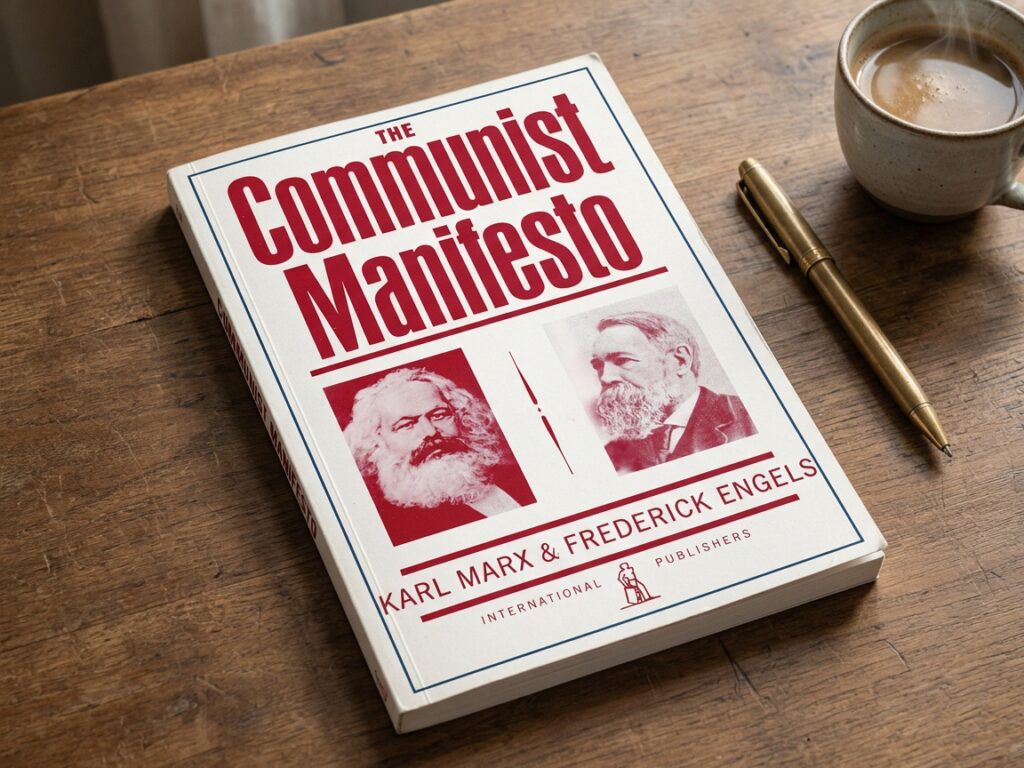
4. The Communist Manifesto
By Karl Marx and Friedrich Engels
First published in 1848, The Communist Manifesto is a short political text by Karl Marx and Friedrich Engels. It presents their interpretation of history through class conflict and examines the rise of the bourgeoisie, the position of the proletariat and the expansion of capitalist production and markets. Marx and Engels argue that capitalism transforms social relationships and creates tensions between those who own productive property and those who sell their labour. The pamphlet also sets out the authors’ case for political organisation by the working class, explains how they distinguish communists from other socialist movements of their time, and outlines a programme for revolutionary change. It became one of the most influential and contested political texts in modern history. Its arguments should be read in their nineteenth-century context and distinguished from the many political movements and governments that later claimed to act in its name.
Inside the Book
Preamble: The authors announce communism as a political force in Europe and respond to the fear and criticism directed at it.
I. Bourgeois and Proletarians: Marx and Engels describe historical class struggles and the rise of the bourgeoisie, then analyse how capitalism transforms production, society and the working class.
II. Proletarians and Communists: The authors explain the relationship between communists and the wider workers’ movement, defend their aims and outline political measures they believe can begin a transformation of society.
III. Socialist and Communist Literature: The manifesto distinguishes their position from feudal, bourgeois, petty-bourgeois, German and other socialist currents of the period.
IV. Position of the Communists in Relation to the Various Existing Opposition Parties: The final section discusses how communists should relate to opposition movements in different countries and closes with a call for international working-class solidarity.
Why it matters: Whether readers agree with its conclusions or not, it provides a direct route into debates about class, economic power, labour, capitalism and political change.
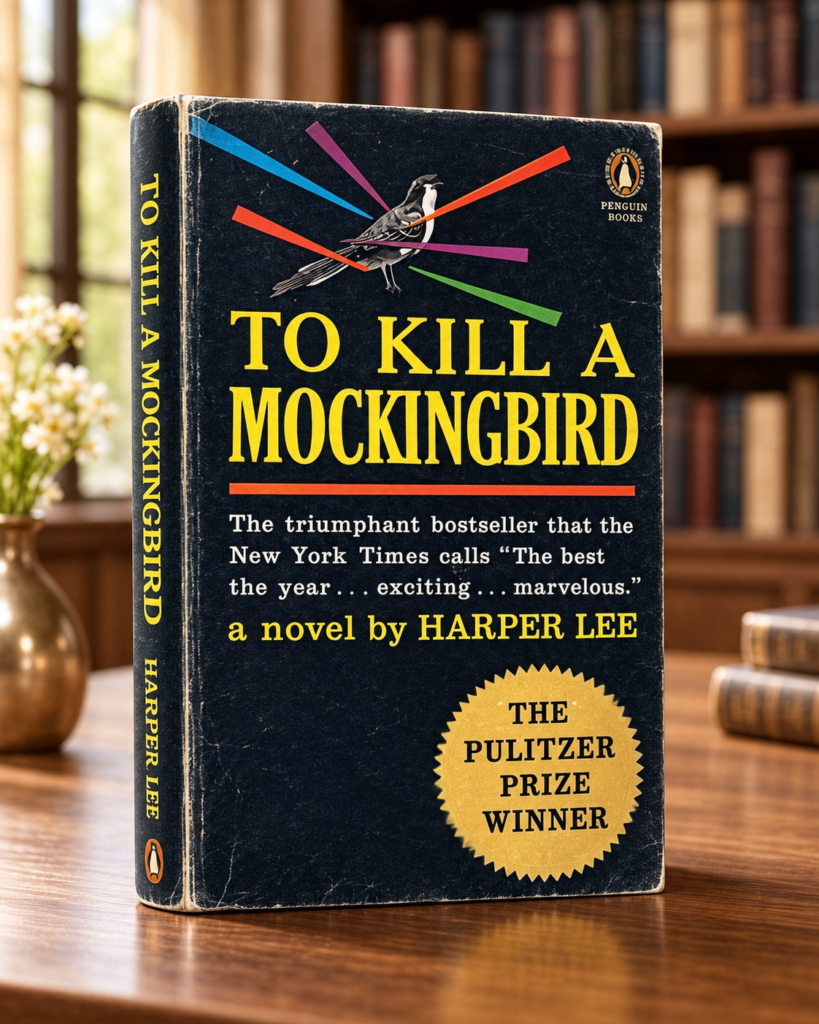
5. To Kill a Mockingbird
By Harper Lee
Set in the American South during the 1930s, Harper Lee’s novel is narrated by Scout Finch, whose childhood understanding of her community changes as she and her brother Jem encounter prejudice, injustice and unfamiliar people. Their father, Atticus Finch, defends Tom Robinson, a Black man falsely accused of assaulting a white woman, in a trial shaped by racial discrimination and an unequal legal system. Alongside the courtroom story, the children’s fascination with their reclusive neighbour Arthur ‘Boo’ Radley develops into a parallel exploration of fear, kindness and mistaken judgement. Through these experiences, the novel examines conscience, empathy, courage, social class, gender expectations and the gap between a society’s stated ideals and its actions. Its treatment of race and justice has made it widely read and widely discussed, including for the way Scout’s limited perspective shapes what readers see and what remains outside her understanding.
Inside the Book
Structure note: The novel has 31 chapters, commonly presented in two broad parts in study editions; the original text itself does not give these parts separate titles. The guide below follows the novel’s chapter order.
Chapter 1: Scout introduces Maycomb, the Finch family and Dill; the children become fascinated by the reclusive Boo Radley.
Chapter 2: Scout begins school and clashes with Miss Caroline, whose teaching methods do not fit the realities of Maycomb.
Chapter 3: Scout learns about Walter Cunningham’s circumstances and receives a lesson in empathy and manners from Calpurnia.
Chapter 4: Scout and Jem find small gifts in the knothole of the Radley oak, deepening their curiosity about Boo.
Chapter 5: Miss Maudie offers Scout a more thoughtful account of Boo and challenges the children’s assumptions.
Chapter 6: The children attempt to look into the Radley house at night; Jem loses his trousers while escaping.
Chapter 7: Jem discovers that his mended trousers and the gifts in the tree may be signs of Boo’s kindness.
Chapter 8: An unusually cold winter brings snow and a fire at Miss Maudie’s house; Scout later learns Boo placed a blanket around her.
Chapter 9: Scout faces schoolyard prejudice after Atticus agrees to defend Tom Robinson, and Atticus explains why he must take the case.
Chapter 10: Atticus shoots a rabid dog, revealing a skill he had kept private and prompting Scout to reconsider what courage means.
Chapter 11: Jem damages Mrs Dubose’s flowers and must read to her; after her death, Atticus explains her struggle with morphine addiction and her courage.
Chapter 12: Jem and Scout attend Calpurnia’s church and encounter a different side of Maycomb’s Black community.
Chapter 13: Aunt Alexandra comes to stay and tries to impose ideas about family status and proper behaviour on the children.
Chapter 14: Dill runs away and appears at the Finch home; the children also confront tension over Aunt Alexandra’s presence.
Chapter 15: Atticus faces a group of men outside the jail, and Scout’s innocent conversation helps defuse the threat to Tom Robinson.
Chapter 16: The children attend the trial and observe the racial divisions surrounding the courthouse.
Chapter 17: During the trial, Heck Tate and Bob Ewell give testimony about the alleged assault and the events that brought Tom to court.
Chapter 18: Mayella Ewell testifies, and Atticus’s questioning exposes contradictions and the isolation surrounding her life.
Chapter 19: Tom Robinson gives his account and explains that he helped Mayella out of sympathy; the testimony reveals the imbalance of power.
Chapter 20: During a break, Dolphus Raymond explains his way of living outside Maycomb’s racial conventions to Scout and Dill.
Chapter 21: Atticus delivers his closing argument, and the jury returns a guilty verdict despite the weaknesses in the prosecution’s case.
Chapter 22: Jem struggles to accept the verdict, while the Black community shows its respect for Atticus.
Chapter 23: Atticus discusses the trial’s aftermath and the children reflect on social class, gender and the limits placed on people.
Chapter 24: At the missionary circle, Scout observes the contrast between charitable language and prejudice towards local Black residents.
Chapter 25: News of Tom Robinson’s death reaches the Finch family, and the community reacts to the loss.
Chapter 26: Scout returns to school and hears more about current events; the Radley story briefly recedes from the children’s attention.
Chapter 27: Bob Ewell threatens Atticus and later attacks the judge’s home, making the danger to the Finch family clearer.
Chapter 28: On Halloween, Scout and Jem walk home from a school pageant and are attacked in the dark.
Chapter 29: Scout discovers that an unknown person has carried Jem home and learns that Bob Ewell has been killed.
Chapter 30: Sheriff Tate and Atticus discuss how to handle the death, while Scout begins to understand who protected her and Jem.
Chapter 31: Scout walks Boo Radley home and, standing on his porch, imagines the neighbourhood from his perspective.
Why it matters: The story encourages readers to consider empathy, moral responsibility and the human consequences of prejudice, while reflecting on how childhood experience can develop into a more mature understanding of others.
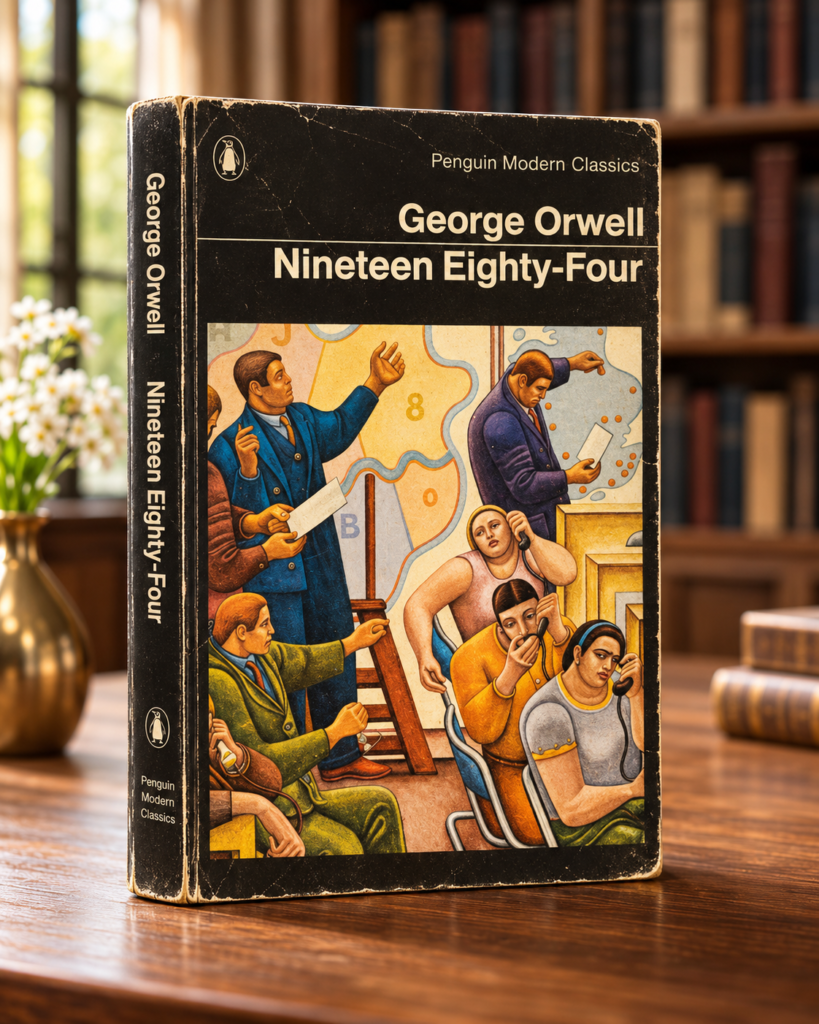
6. Nineteen Eighty-Four (1984)
By George Orwell
George Orwell’s dystopian novel depicts a society in which the Party seeks to control not only public behaviour but also language, memory and private thought. Winston Smith works at the Ministry of Truth, where he alters historical records, while privately questioning the system that governs his life. Through constant surveillance, propaganda, censorship and the manipulation of information, Orwell examines how authoritarian power can weaken individual freedom and undermine any shared understanding of reality. The novel introduces ideas such as Newspeak, a restricted language intended to narrow the range of thought, and doublethink, the ability to accept contradictory beliefs. Winston’s experiences show how political control can extend into personal relationships, memory and a person’s sense of self. The novel is fiction, but its political ideas continue to inform discussions about state power, information and civil liberties.
Inside the Book
Structure note: The novel has three parts containing 24 chapters in total, followed by an appendix on Newspeak. The chapter summaries below follow the standard three-part structure.
Part I, Chapter 1: Winston Smith’s daily life in Airstrip One is introduced as he secretly begins a diary, an act forbidden by the Party.
Part I, Chapter 2: Winston encounters his neighbour Mrs Parsons and her children, whose enthusiasm for the Party shows how political surveillance and indoctrination reach into family life.
Part I, Chapter 3: Winston dreams of his mother and childhood, remembers fragments of the past and reflects on the Party’s control of memory.
Part I, Chapter 4: At the Ministry of Truth, Winston alters old newspaper records so that the past continually matches the Party’s current claims.
Part I, Chapter 5: Winston talks with Syme about the development of Newspeak and sees how reducing language could make independent thought harder.
Part I, Chapter 6: Winston records memories of his marriage and reflects on the Party’s efforts to control sexual relationships and private desire.
Part I, Chapter 7: Winston considers whether the proles could challenge the Party and reflects on the difficulty of knowing what is true about the past.
Part I, Chapter 8: Winston walks through the prole district, visits a pub and enters Mr Charrington’s shop, becoming increasingly drawn to traces of the old world.
Part II, Chapter 1: The dark-haired woman secretly passes Winston a note declaring her love, opening the possibility of a relationship beyond Party control.
Part II, Chapter 2: Winston and Julia meet in the countryside and begin a secret relationship away from the telescreens.
Part II, Chapter 3: The couple find ways to meet and discuss their different experiences of rebellion, desire and life under the Party.
Part II, Chapter 4: Winston rents the room above Mr Charrington’s shop as a private refuge where he and Julia can spend time together.
Part II, Chapter 5: The Party prepares for Hate Week, and Winston notices changes in colleagues and slogans as public propaganda intensifies.
Part II, Chapter 6: O’Brien speaks to Winston and gives him an opportunity to visit, leading Winston to believe that he may be connected with the Brotherhood.
Part II, Chapter 7: Winston reflects on his mother, childhood and the human bonds that existed before the Party’s domination.
Part II, Chapter 8: Winston and Julia visit O’Brien, who appears to confirm their suspicions about the Brotherhood and gives Winston access to a forbidden book.
Part II, Chapter 9: During Hate Week, Winston reads the book attributed to Goldstein, which explains the Party’s social structure, perpetual war and methods of control.
Part II, Chapter 10: The apparent safety of the room above the shop collapses when the Thought Police arrest Winston and Julia.
Part III, Chapter 1: Winston is held in the Ministry of Love, where he encounters prisoners and begins to understand the scale of the Party’s power.
Part III, Chapter 2: O’Brien reveals that he is working for the Party and begins the process of interrogating and psychologically breaking Winston.
Part III, Chapter 3: O’Brien explains the Party’s view of power and reality while torture forces Winston to accept claims that contradict his own perceptions.
Part III, Chapter 4: After prolonged interrogation, Winston is physically and mentally weakened and begins to internalise the Party’s version of reality.
Part III, Chapter 5: In Room 101, Winston confronts his greatest fear and betrays Julia, completing the destruction of his private loyalty.
Part III, Chapter 6: After his release, Winston lives an empty, compliant life; the novel ends with his complete acceptance of Big Brother.
Why it matters: It sharpens awareness of propaganda, surveillance, language and the importance of protecting independent thought and reliable records.
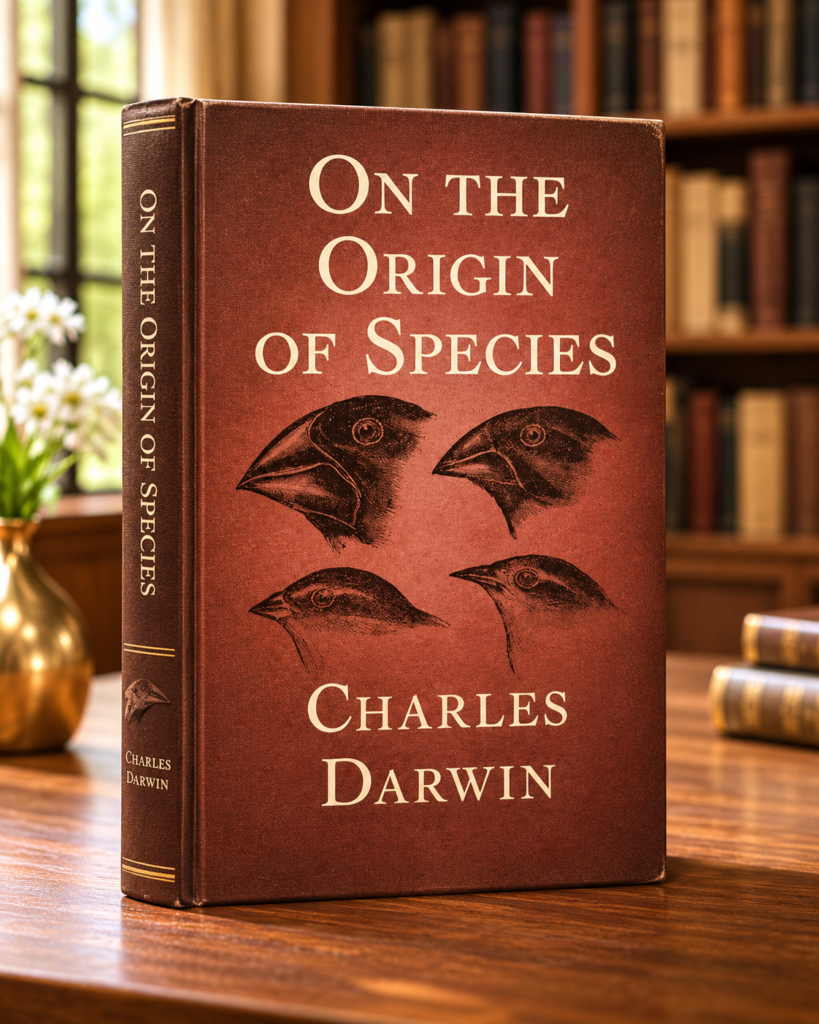
7. On the Origin of Species
By Charles Darwin
Published in 1859, Charles Darwin’s On the Origin of Species sets out an extended argument for evolution by natural selection. Darwin begins with variation among domesticated and wild organisms, then considers the struggle for existence and how inherited variations that help organisms survive and reproduce can become more common over generations. He also discusses sexual selection, the divergence of species, extinction, geographical distribution, the geological record, comparative anatomy, embryology and rudimentary organs. Together, these lines of evidence support his account of the diversity of life and the common ancestry of organisms. The book transformed biology and challenged prevailing explanations of how species arise. Darwin wrote before the development of modern genetics, and evolutionary science has advanced considerably since his time, but the work remains a landmark in the history of scientific thought.
Inside the Book
Introduction: Darwin sets out the problem of species and previews the evidence and argument developed in the book.
Chapter I — Variation under Domestication: Examples from breeding and domesticated animals show how variation arises and how deliberate or unconscious selection can produce change.
Chapter II — Variation under Nature: Darwin considers individual differences and the difficulty of drawing fixed boundaries between varieties and species.
Chapter III — Struggle for Existence: The capacity of organisms to reproduce faster than resources allow creates competition and complex relationships throughout nature.
Chapter IV — Natural Selection: Darwin explains how favourable inherited variations can be preserved, accumulate and contribute to adaptation and divergence.
Chapter V — Laws of Variation: He examines possible causes and patterns of variation, including the effects of use, disuse, correlation and inheritance as understood in his time.
Chapter VI — Difficulties on Theory: Darwin addresses apparent challenges to natural selection, including complex organs and transitional forms.
Chapter VII — Instinct: He considers instinctive behaviour and asks how complex patterns of behaviour might develop through selection.
Chapter VIII — Hybridism: Darwin examines sterility and fertility in crosses between species and considers how these patterns relate to species boundaries.
Chapter IX — Imperfection of the Geological Record: He explains why the fossil record is incomplete and why intermediate forms may be missing.
Chapter X — Geological Succession of Organic Beings: The succession and extinction of organisms in geological strata are considered as evidence for change over time.
Chapter XI — Geographical Distribution: Darwin examines how species are distributed across continents and islands and how geography supports evolutionary explanations.
Chapter XII — Geographical Distribution, continued: He considers island species, barriers to migration and the relationships between organisms in different regions.
Chapter XIII — Mutual Affinities, Morphology, Embryology and Rudimentary Organs: Similarities in body structure, development and reduced organs are used to support common descent.
Chapter XIV — Recapitulation and Conclusion: Darwin draws the argument together, responds to remaining objections and considers the wider implications of natural selection.
Why it matters: It demonstrates how careful observation, evidence and a powerful explanatory theory can transform our understanding of the natural world and the relationships among living organisms.
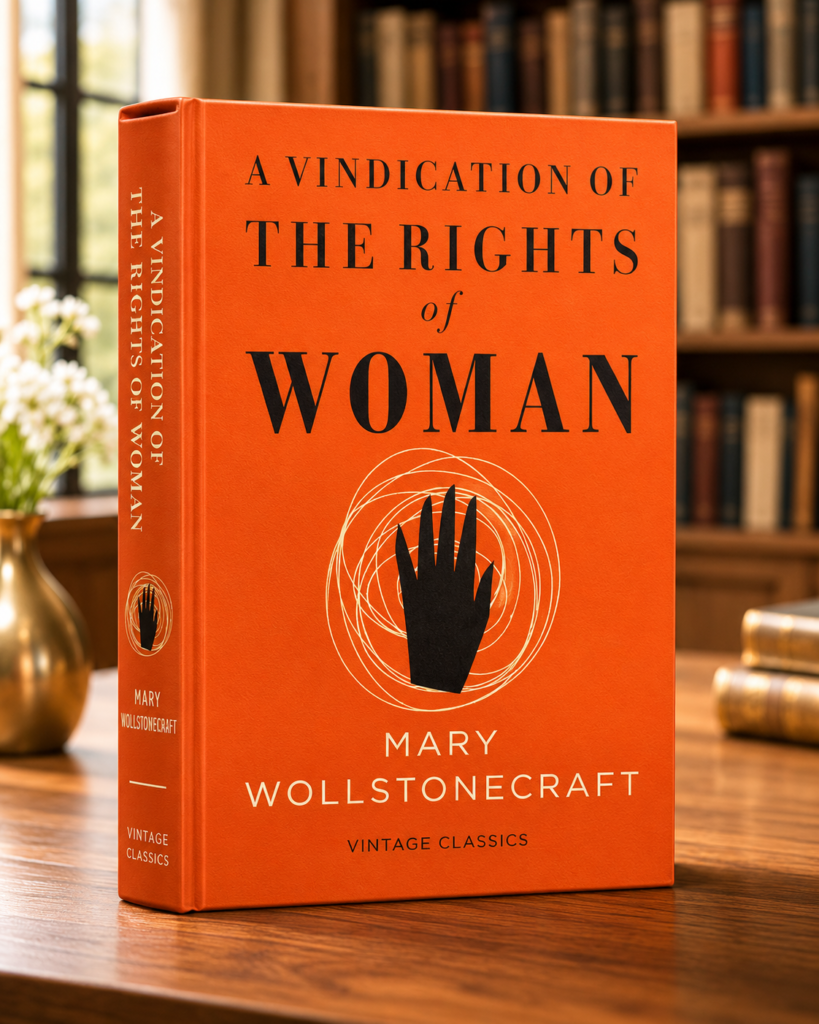
8. A Vindication of the Rights of Woman
By Mary Wollstonecraft
Published in 1792, Mary Wollstonecraft’s A Vindication of the Rights of Woman argues that women are not naturally inferior to men; rather, unequal education and restrictive social expectations prevent many women from developing their abilities. Wollstonecraft makes a case for education that develops women’s reason, knowledge, moral judgement and independence, instead of training them primarily to please men or conform to expectations of appearance and obedience. She considers the effects of marriage, dependence and women’s limited opportunities, and connects education with the ability to act as responsible members of society. The book emerged from the political debates of its time and became an important text in the history of feminist thought, although later feminist movements have developed and challenged aspects of its arguments.
Inside the Book
Introduction: Wollstonecraft frames her argument around the rights and duties of human beings and the need to educate women as rational members of society.
Chapter I — The Rights and Involved Duties of Mankind Considered: She establishes the relationship between reason, virtue and rights, arguing that women must be included in a serious account of moral and civic development.
Chapter II — The Prevailing Opinion of a Sexual Character Discussed: She challenges claims that women are naturally intellectually inferior and criticises education that trains them to please men.
Chapter III — The Same Subject Continued: She examines how dependence, social expectations and limited education shape women’s behaviour and opportunities.
Chapter IV — The State of Degradation to Which Woman Is Reduced: She considers the social, economic and educational causes that restrict women’s independence and encourage superficial accomplishments.
Chapter V — Writers Who Have Made Women Objects of Pity: She disputes influential writers whose advice, in her view, reinforces women’s weakness and dependence.
Chapter VI — The Effect of Early Associations of Ideas: She explores how childhood education and repeated social messages shape character and judgement.
Chapter VII — Modesty: She distinguishes genuine modesty from the sexualised idea of modesty imposed on women.
Chapter VIII — Morality and Reputation: She argues that morality is weakened when women are judged primarily by sexual reputation rather than by reason and conduct.
Chapter IX — Unnatural Distinctions in Society: She criticises artificial social ranks and gender distinctions that prevent people from developing virtue and independence.
Chapter X — Parental Affection: She considers how rational education and parental responsibility affect family relationships and the upbringing of children.
Chapter XI — Duty to Parents: She discusses respect and responsibility within families, while questioning unquestioning obedience.
Chapter XII — National Education: She proposes a broader system of education in which girls and boys learn together and are prepared for useful participation in society.
Chapter XIII — Ignorance and the Moral Improvement of Women: She gathers examples of the harm caused by women’s lack of education and concludes with a call for changes in social attitudes and women’s conduct.
Why it matters: It asks readers to examine how education, opportunity and social expectations shape people’s abilities, independence and prospects.
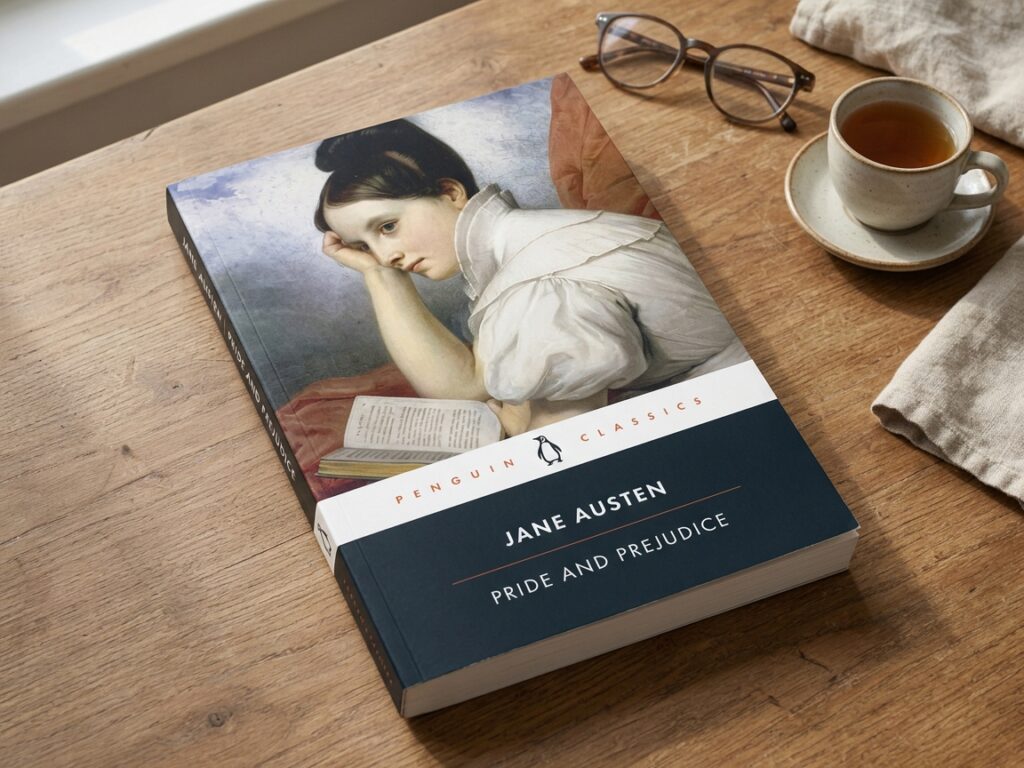
9. Pride and Prejudice
By Jane Austen
Jane Austen’s novel follows Elizabeth Bennet and her family as they navigate social expectations, financial insecurity and the marriage market of early nineteenth-century England. The Bennet family’s position is made precarious by the inheritance system, which means their home is entailed away from the daughters. Elizabeth’s first impressions of Fitzwilliam Darcy—and his of her—are gradually tested as both characters confront their assumptions and misread one another. Alongside their developing relationship, the novel follows Jane Bennet and Mr Bingley and explores the pressures that shape the sisters’ prospects. With sharp humour and close observation, Austen examines pride, prejudice, reputation, money, class, family and the limited economic choices available to women. The novel is both a compelling love story and a subtle examination of the society in which its characters live.
Inside the Book
Structure note: The novel has 61 chapters, originally published in three volumes (Chapters 1–23, 24–42 and 43–61). The guide below follows the original chapter numbering.
Chapter 1: The Bennet family learns that Netherfield Park has been let to a wealthy bachelor, prompting Mrs Bennet to hope one of her daughters may marry him.
Chapter 2: Mr Bennet secretly visits the new tenant, Mr Bingley, and surprises his wife by revealing the visit.
Chapter 3: At the Meryton assembly, Bingley dances with Jane, while Darcy’s dismissive remark about Elizabeth gives her a poor first impression of him.
Chapter 4: Jane and Elizabeth discuss the newcomers; Jane sees the best in everyone, while Elizabeth is amused by Darcy’s pride.
Chapter 5: The Lucas family discuss the Bingleys and Darcy, and Charlotte offers her practical view of marriage and courtship.
Chapter 6: At Netherfield, Elizabeth observes the Bingley sisters’ behaviour and exchanges conversation with Darcy, whose interest in her begins to grow.
Chapter 7: Jane rides to Netherfield, catches a cold and is invited to remain there; Elizabeth walks through the mud to nurse her.
Chapter 8: Elizabeth stays at Netherfield with Jane, while Miss Bingley attempts to attract Darcy and criticises Elizabeth’s appearance and family.
Chapter 9: Mrs Bennet visits Jane and embarrasses Elizabeth; conversation also reveals more about the sisters’ views of marriage and social conduct.
Chapter 10: Darcy and Elizabeth continue their lively exchanges, while Miss Bingley tries to draw Darcy’s attention away from Elizabeth.
Chapter 11: Elizabeth spends more time with Jane and the Bingley party; Darcy’s admiration becomes more apparent despite their differences.
Chapter 12: Jane recovers, and the sisters return to Longbourn after their stay at Netherfield.
Chapter 13: Mr Collins writes to announce his visit and his wish to make amends with the Bennet family, whom he may eventually displace as heir to Longbourn.
Chapter 14: Mr Collins arrives, displays his obsequious manner and repeatedly praises his patroness, Lady Catherine de Bourgh.
Chapter 15: Mr Collins considers which Bennet daughter to marry; in Meryton, Elizabeth meets the charming officer Mr Wickham.
Chapter 16: Wickham tells Elizabeth his account of his past with Darcy, and she is inclined to believe him.
Chapter 17: Jane receives news of the Netherfield ball, while the Bennet household prepares for the event and Elizabeth anticipates seeing Wickham.
Chapter 18: At the Netherfield ball, Darcy dances with Elizabeth, Wickham is absent, and the Bennet family’s behaviour causes embarrassment.
Chapter 19: Mr Collins proposes to Elizabeth, who refuses him firmly despite his inability to accept her answer.
Chapter 20: Mrs Bennet is distressed by Elizabeth’s refusal and appeals to Mr Bennet to make her accept Collins.
Chapter 21: Charlotte Lucas visits Longbourn; Jane’s hopes of seeing Bingley again remain uncertain.
Chapter 22: Charlotte accepts Mr Collins, explaining that she values the security marriage can provide; Elizabeth is disappointed by her friend’s decision.
Chapter 23: Jane learns that the Bingleys have left Netherfield, and Elizabeth suspects that Bingley’s sisters have influenced his departure.
Chapter 24: Caroline Bingley writes to Jane from London, confirming the party’s absence and encouraging the belief that Bingley may marry Georgiana Darcy.
Chapter 25: Jane visits the Gardiners in London, hoping to see Bingley, but Caroline avoids giving her encouragement.
Chapter 26: Elizabeth learns more about Jane’s disappointment and prepares to travel to Hunsford to visit Charlotte and Mr Collins.
Chapter 27: Elizabeth travels to Kent with Sir William Lucas and Maria, looking forward to seeing Charlotte at the parsonage.
Chapter 28: Elizabeth settles into life at Hunsford and visits Rosings, where she meets Lady Catherine de Bourgh.
Chapter 29: Lady Catherine questions Elizabeth about her family and upbringing, while Elizabeth observes the household’s formal social hierarchy.
Chapter 30: Elizabeth encounters Darcy and Colonel Fitzwilliam at Rosings and becomes more familiar with their visits and conversation.
Chapter 31: At a gathering at Rosings, Elizabeth plays the piano and continues to exchange conversation with Darcy.
Chapter 32: Darcy visits the Hunsford parsonage, while Elizabeth is surprised by his frequent presence and attempts to understand his manner.
Chapter 33: Colonel Fitzwilliam tells Elizabeth that Darcy recently intervened in a friend’s relationship; Elizabeth realises that Jane may be the person concerned.
Chapter 34: Darcy proposes to Elizabeth, declaring his love while emphasising the social obstacles he believes he has overcome.
Chapter 35: Elizabeth rejects Darcy, criticising his treatment of Wickham and his interference in Jane and Bingley’s relationship.
Chapter 36: Darcy gives Elizabeth a letter explaining his history with Wickham and his reasons for separating Bingley from Jane.
Chapter 37: Darcy and Colonel Fitzwilliam leave Rosings; Elizabeth is relieved by Darcy’s departure but continues to reflect on his letter.
Chapter 38: Elizabeth and Maria prepare to leave Hunsford, and Mr Collins gives Elizabeth an elaborate farewell.
Chapter 39: On the journey home, Elizabeth and Maria stop at an inn and meet Kitty and Lydia, who are full of news and excited about the regiment’s plans.
Chapter 40: Back at Longbourn, Elizabeth tells Jane about Darcy’s proposal and letter, while deciding not to disclose the private details concerning Georgiana.
Chapter 41: Lydia is invited to Brighton by Mrs Forster; Elizabeth warns her father about Lydia’s behaviour, but Mr Bennet allows her to go.
Chapter 42: The narrator reflects on the Bennets’ marriage and family circumstances; Elizabeth then sets out on a summer tour of Derbyshire with the Gardiners.
Chapter 43: Elizabeth visits Pemberley with the Gardiners, hears the housekeeper’s praise of Darcy and unexpectedly encounters Darcy himself.
Chapter 44: Darcy treats Elizabeth and the Gardiners with courtesy, and later introduces Elizabeth to his sister Georgiana.
Chapter 45: At Pemberley, Elizabeth meets the Bingleys; Miss Bingley attempts to disparage her, but Darcy openly praises Elizabeth’s appearance.
Chapter 46: Letters from Jane reveal that Lydia has run away with Wickham; Elizabeth tells Darcy before leaving Pemberley with the Gardiners.
Chapter 47: Elizabeth and the Gardiners travel back to Longbourn, where the family anxiously awaits news of Lydia and Wickham.
Chapter 48: Mr Gardiner joins Mr Bennet in London to search for the couple, while the family at Longbourn receives little news.
Chapter 49: A letter from Mr Gardiner reports that Lydia and Wickham have been found and that Wickham will marry her after a financial settlement.
Chapter 50: Mr Bennet returns home and discusses the financial arrangement; he worries about the money Mr Gardiner may have spent to secure the marriage.
Chapter 51: Lydia and Wickham visit Longbourn after their wedding; Lydia’s conversation reveals that Darcy attended the wedding.
Chapter 52: Mrs Gardiner’s letter explains that Darcy found Lydia and Wickham, paid Wickham’s debts and arranged the marriage and settlement.
Chapter 53: Lydia and Wickham leave Longbourn for his new posting, and news arrives that Bingley is returning to Netherfield.
Chapter 54: Bingley and Darcy visit Longbourn; Bingley’s renewed attention to Jane gives the family reason to hope for a reconciliation.
Chapter 55: Bingley proposes to Jane, who accepts, bringing happiness to the Bennet household.
Chapter 56: Lady Catherine visits Longbourn after hearing a rumour that Darcy may marry Elizabeth; she demands that Elizabeth deny the possibility.
Chapter 57: Mr Bennet receives a letter from Mr Collins reporting Lady Catherine’s displeasure and warning of the consequences of an engagement.
Chapter 58: Darcy and Elizabeth walk together; Darcy renews his proposal, and Elizabeth accepts, explaining how her feelings have changed.
Chapter 59: Elizabeth tells Mr Bennet of her engagement; he questions her carefully before giving his consent.
Chapter 60: Elizabeth and Darcy discuss their former misunderstandings and the changes in their feelings, while Jane and Elizabeth share the news and their happiness.
Chapter 61: The final chapter looks ahead to the married lives of the principal characters, including the sisters’ futures, the Gardiners’ continued closeness and Darcy’s efforts to help Wickham without welcoming him at Pemberley.
Why it matters: It reminds readers that first impressions can be misleading, that self-knowledge matters and that relationships are shaped by social and economic pressures as well as personal feeling.
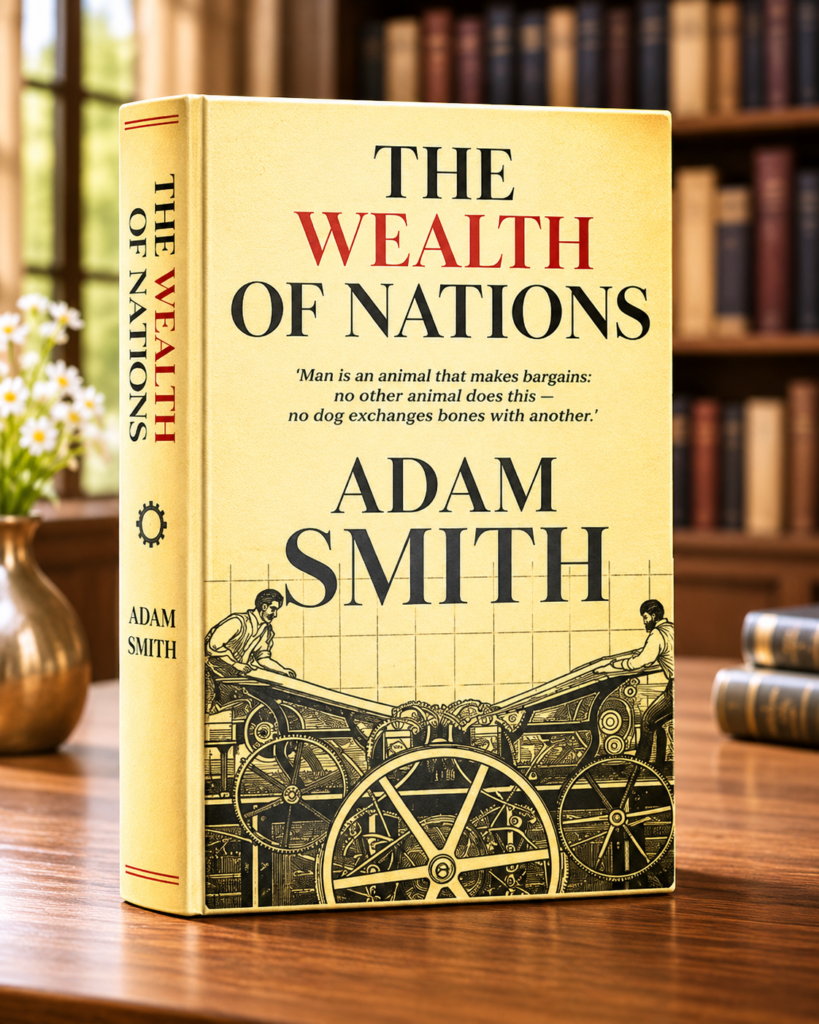
10. An Inquiry into the Nature and Causes of the Wealth of Nations
By Adam Smith
Commonly known as The Wealth of Nations, Adam Smith’s 1776 work examines how economies function and how national prosperity is created. Smith discusses the division of labour and its effect on productivity, the origins and use of money, prices, wages, profits, rent, capital accumulation and economic growth. He analyses domestic and international trade, criticises aspects of the mercantile system and considers how markets and commercial activity develop. The work also devotes substantial attention to public institutions: Smith examines the responsibilities of government in defence, justice, public works, infrastructure and education, as well as taxation and public revenue. It is often associated with the development of modern economics, but it should not be reduced to a simple defence of unrestricted markets. Smith’s arguments belong to the economic and political debates of his period and are best approached in that historical context.
Inside the Book
Structure note: The work is arranged in five Books, with an introductory plan and a total of 32 numbered chapters in the standard full text. Chapter titles are often long; the guide below gives their subjects in concise form.
Introduction and Plan of the Work: Smith outlines his inquiry into the sources of national wealth and the organisation of economic activity.
Book I, Chapter 1 — Division of Labour: The pin factory illustrates how specialisation can greatly increase productivity.
Book I, Chapter 2 — Principle behind Division of Labour: Smith links specialisation to people’s propensity to exchange and trade.
Book I, Chapter 3 — Extent of the Market: The size of the market limits how far labour can be divided into specialised tasks.
Book I, Chapter 4 — Origin and Use of Money: Money emerges as a practical medium that makes exchange easier than barter.
Book I, Chapter 5 — Real and Nominal Price: Smith distinguishes the labour value of goods from their money prices and considers changes in purchasing power.
Book I, Chapter 6 — Components of Price: He explains how wages, profit and rent enter into the price of commodities.
Book I, Chapter 7 — Natural and Market Price: The chapter distinguishes ordinary market fluctuations from prices around which markets tend to gravitate.
Book I, Chapter 8 — Wages of Labour: Smith examines wages, bargaining power, population growth and the circumstances that raise or lower workers’ pay.
Book I, Chapter 9 — Profits of Stock: He considers the factors affecting returns to invested capital and the relationship between profits and competition.
Book I, Chapter 10 — Wages and Profit across Employments: Smith explains differences in pay and profit arising from the nature of occupations and from public policy.
Book I, Chapter 11 — Rent of Land: He analyses land rent, agricultural produce and historical changes in the relative value of commodities.
Book II, Chapter 1 — Division of Stock: Smith distinguishes fixed and circulating capital and considers how stock supports production.
Book II, Chapter 2 — Money as Part of Social Stock: He discusses money, banking and the ways financial arrangements can economise on the resources society uses as capital.
Book II, Chapter 3 — Accumulation of Capital: The chapter examines saving, investment and the distinction between productive and unproductive labour.
Book II, Chapter 4 — Stock Lent at Interest: Smith considers lending, interest and the uses of borrowed capital.
Book II, Chapter 5 — Different Employments of Capitals: He compares how capital is employed in agriculture, manufacturing, wholesale trade and retail trade.
Book III, Chapter 1 — Natural Progress of Opulence: Smith describes the order in which agriculture, manufacturing and commerce tend to develop.
Book III, Chapter 2 — Agriculture in Medieval Europe: He explains how feudal institutions and insecurity discouraged agricultural improvement after the fall of Rome.
Book III, Chapter 3 — Rise of Cities and Towns: The growth of towns and commerce gradually changes European economic and social relationships.
Book III, Chapter 4 — Commerce and the Country: Smith explains how urban trade helped stimulate agricultural improvement and wider prosperity.
Book IV, Chapter 1 — Mercantile System: He introduces and criticises the belief that national wealth depends primarily on accumulating precious metals and maintaining trade surpluses.
Book IV, Chapter 2 — Import Restrictions: Smith examines protectionist restrictions on imports and their effects on competition and consumers.
Book IV, Chapter 3 — Further Import Restraints: He analyses additional trade restrictions and the arguments used to justify them.
Book IV, Chapter 4 — Drawbacks: The chapter considers refunds of duties on goods that are exported or re-exported.
Book IV, Chapter 5 — Bounties: Smith examines export subsidies and their economic consequences.
Book IV, Chapter 6 — Treaties of Commerce: He discusses trade agreements and the political and economic interests behind them.
Book IV, Chapter 7 — Colonies: Smith examines the motives for colonial expansion, colonial economic development and the costs and benefits of empire and trade.
Book IV, Chapter 8 — Conclusion of the Mercantile System: He draws together his critique of mercantilist policy and its effects.
Book IV, Chapter 9 — Agricultural Systems: Smith evaluates theories that treat land or agricultural production as the sole or principal source of national wealth.
Book V, Chapter 1 — Expenses of the Sovereign: He considers public spending on defence, justice, infrastructure, education and the dignity of the state.
Book V, Chapter 2 — Sources of Public Revenue: Smith examines taxation and other sources of government income, including principles for designing taxes.
Book V, Chapter 3 — Public Debts: The final chapter discusses government borrowing, public debt and the fiscal consequences of war and expenditure.
Why it matters: It provides a foundation for thinking about production, trade, incentives, economic growth and the public institutions that help shape economic life.
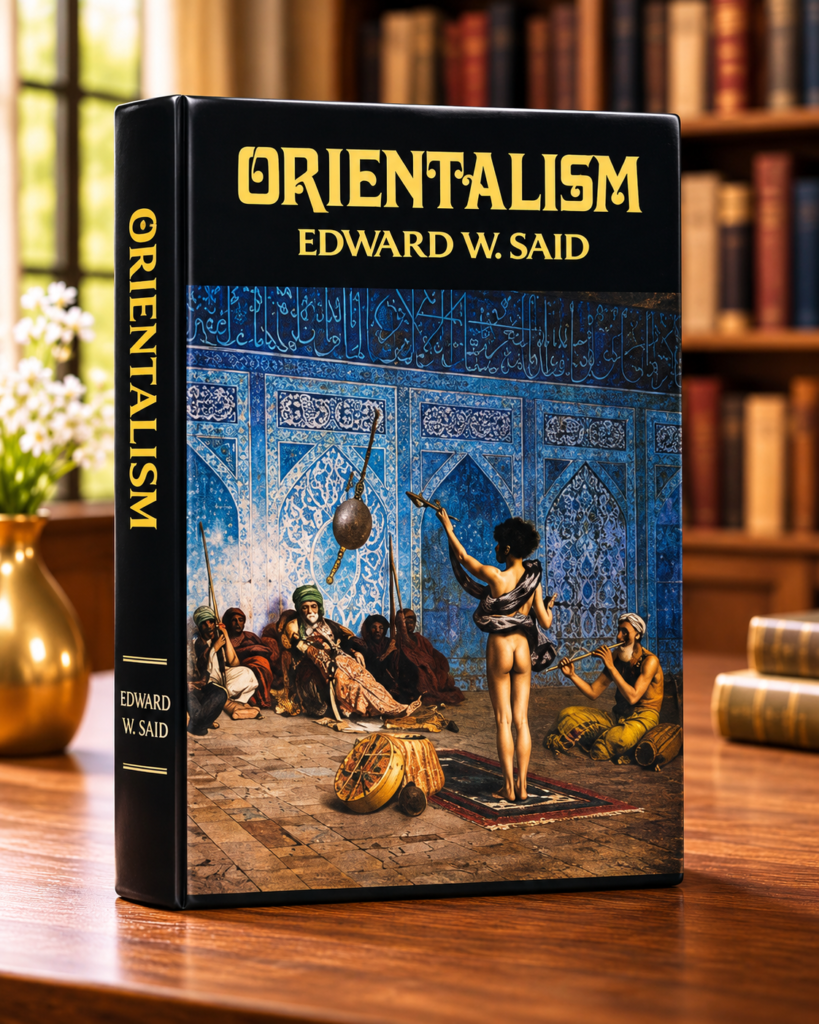
11. Orientalism
By Edward W. Said
First published in 1978, literary critic Edward W. Said’s Orientalism examines how European and American scholarship, literature and cultural institutions produced and circulated ideas about ‘the Orient’. Said argues that these representations often treated diverse societies as a single, simplified object of study and were connected to the exercise of imperial power. He traces how academic knowledge, travel writing, literature and political authority could reinforce one another, shaping what Western audiences believed about Eastern societies and who was regarded as entitled to describe them. The book is not simply a catalogue of negative stereotypes: it examines a wider system of representation and authority through which the East was interpreted and governed. Orientalism became foundational in postcolonial studies and generated extensive debate. It is best read as a major critical argument about knowledge, representation and power, rather than as a complete account of every interaction between Western and Eastern societies.
Inside the Book
Introduction: Said defines Orientalism as a system of representation and knowledge through which the West has historically imagined and studied the East.
Chapter 1 — The Scope of Orientalism: The chapter establishes the field and its history through four sections: how the ‘Oriental’ is known, how imaginative geography divides East and West, how Orientalist projects operate, and how the system enters periods of crisis.
Chapter 2 — Orientalist Structures and Restructures: Said traces the development of modern Orientalist scholarship and institutions, examining changing boundaries, influential scholars, academic practices and the experiences of British and French travellers and residents.
Chapter 3 — Orientalism Now: The final chapter distinguishes latent assumptions from explicit statements, examines the style and authority of Orientalist expertise, follows the growth of Anglo-French Orientalism and considers its later American phase.
Afterword: In editions that include it, Said responds to debates and criticisms that followed the book’s publication and clarifies the scope of his argument.
Why it matters: It encourages readers to question stereotypes, examine who produces knowledge and consider how cultural narratives and institutions can reinforce unequal power.
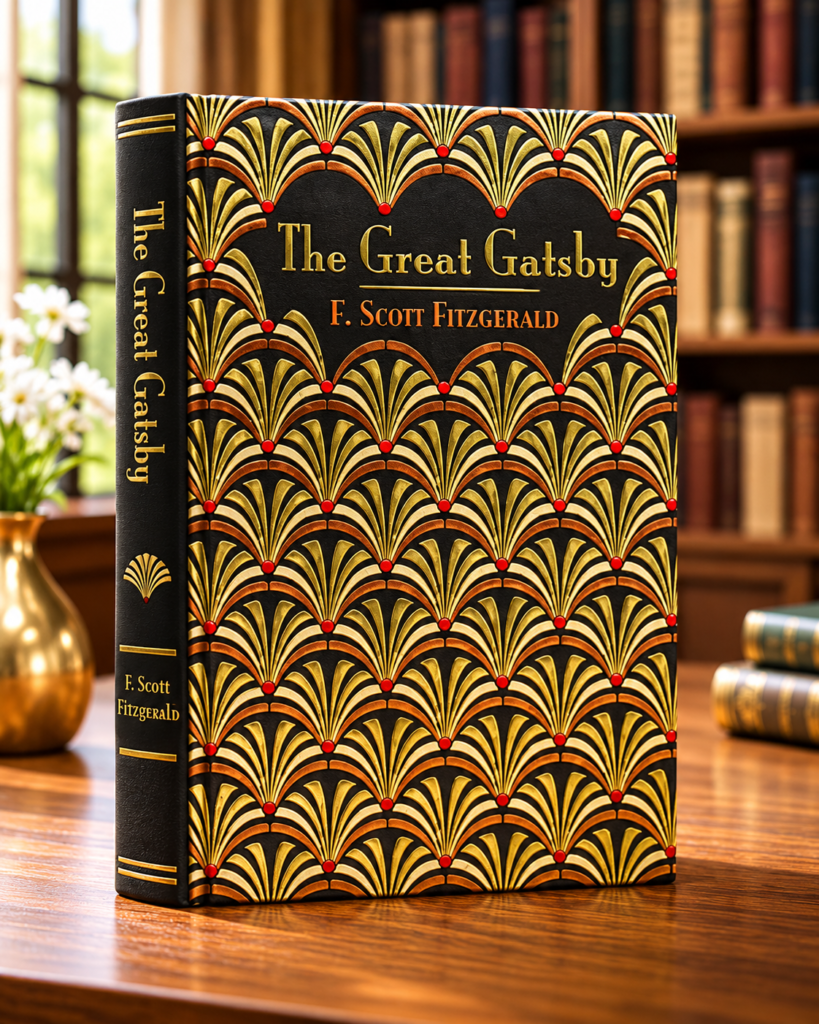
12. The Great Gatsby
By F. Scott Fitzgerald
Set among wealthy communities on Long Island during the 1920s, F. Scott Fitzgerald’s novel is narrated by Nick Carraway, who becomes drawn into the world of the mysterious Jay Gatsby. Gatsby’s longing for Daisy Buchanan unfolds against a background of wealth, social ambition and moral carelessness. The novel contrasts established ‘old money’ families with people whose wealth is more recently acquired, revealing how class boundaries can persist even when fortunes change. Through Gatsby’s idealised memories and hopes, Fitzgerald explores the American Dream, desire, memory, social status and the distance between aspiration and reality. Nick’s retrospective narration also shapes the reader’s understanding of Gatsby and the people around him. The novel’s restrained narration and vivid imagery make it both a personal tragedy and a critique of the values associated with wealth and privilege.
Inside the Book
Chapter 1 — Nick Comes East: Nick introduces himself, the wealthy Buchanans and the social world of East and West Egg; he glimpses Gatsby reaching towards a distant green light.
Chapter 2 — The Valley of Ashes: Nick accompanies Tom to the industrial wasteland between the Eggs and New York, where he meets Myrtle Wilson and witnesses Tom’s violence.
Chapter 3 — Gatsby’s Party: Nick attends one of Gatsby’s lavish parties, hears rumours about his host and finally meets Gatsby.
Chapter 4 — Gatsby’s Story: Gatsby offers Nick a carefully shaped account of his past, while Jordan explains Gatsby’s history with Daisy and his wish to see her.
Chapter 5 — The Reunion: Nick arranges a meeting between Gatsby and Daisy; their reunion is awkward at first before emotion and memory take over.
Chapter 6 — James Gatz: Nick reveals Gatsby’s humble origins and explains how he created a new identity and pursued wealth and status.
Chapter 7 — The Plaza and the Accident: Tensions erupt during a trip to New York, Daisy’s driving leads to Myrtle’s death and Gatsby takes responsibility for protecting her.
Chapter 8 — Gatsby’s Last Day: Gatsby tells Nick more about his past with Daisy and waits for her call, while George Wilson’s grief turns towards revenge.
Chapter 9 — Boats Against the Current: Nick arranges Gatsby’s funeral, reflects on the emptiness of the social world around him and considers the pull of the past and the American Dream.
Why it matters: It offers a memorable study of ambition and the cost of pursuing an ideal built on illusion, while questioning whether wealth can overcome entrenched social divisions.
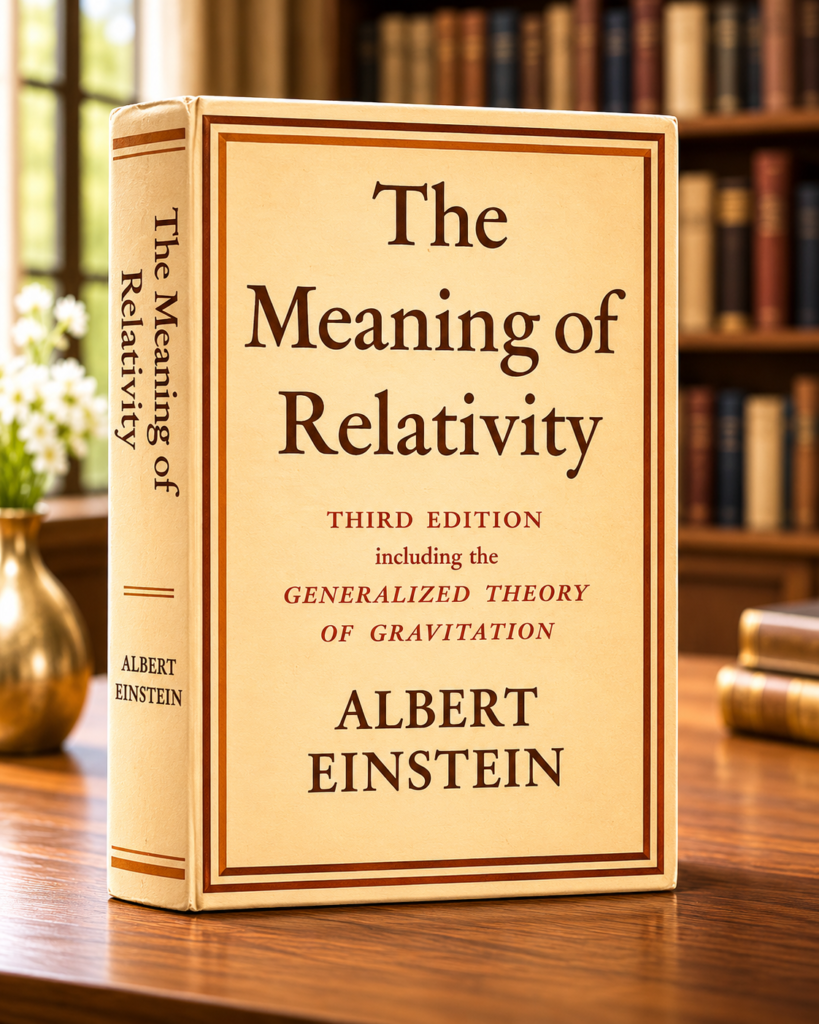
13. The Meaning of Relativity
By Albert Einstein
In The Meaning of Relativity, Albert Einstein presents the central ideas of his theories of special and general relativity and explains their implications for space, time, motion and gravity. The discussion of special relativity concerns the relationship between space and time for observers in relative motion and the consequences for physical measurements. The treatment of general relativity extends the account to gravity, describing it through the geometry of spacetime rather than as an ordinary force acting at a distance. The book also considers cosmological questions and Einstein’s attempts to connect different areas of physical theory. It gives readers a route into Einstein’s own account of a major scientific transformation, but it is a technical work with mathematical reasoning rather than a general popular-science introduction. Readers without a mathematical or physics background may benefit from an introductory guide before tackling the original text.
Inside the Book
Structure note: Einstein revised this work over several editions. A common contents structure has three main chapters and two appendices; later editions may include revised material and different pagination.
Chapter 1 — Space and Time in Pre-Relativity Physics: Einstein reviews the classical ideas of space, time and motion that preceded relativity and explains the problems that prompted a new framework.
Chapter 2 — The Theory of Special Relativity: He develops the principles of special relativity and their consequences for measurements of time, distance, simultaneity and physical laws.
Chapter 3 — The General Theory of Relativity: Einstein extends the theory to accelerated motion and gravity, explaining the geometrical description of gravitation and its physical implications.
Appendix I — The Cosmological Problem: He considers how general relativity applies to the universe as a whole and to cosmological models.
Appendix II — The Relativistic Theory of the Non-Symmetric Field: Einstein presents a later attempt to extend the mathematical framework of relativity towards a unified field description.
Why it matters: It shows how scientific theories can change fundamental concepts that people once assumed were fixed and intuitive, particularly our understanding of space, time and gravity.
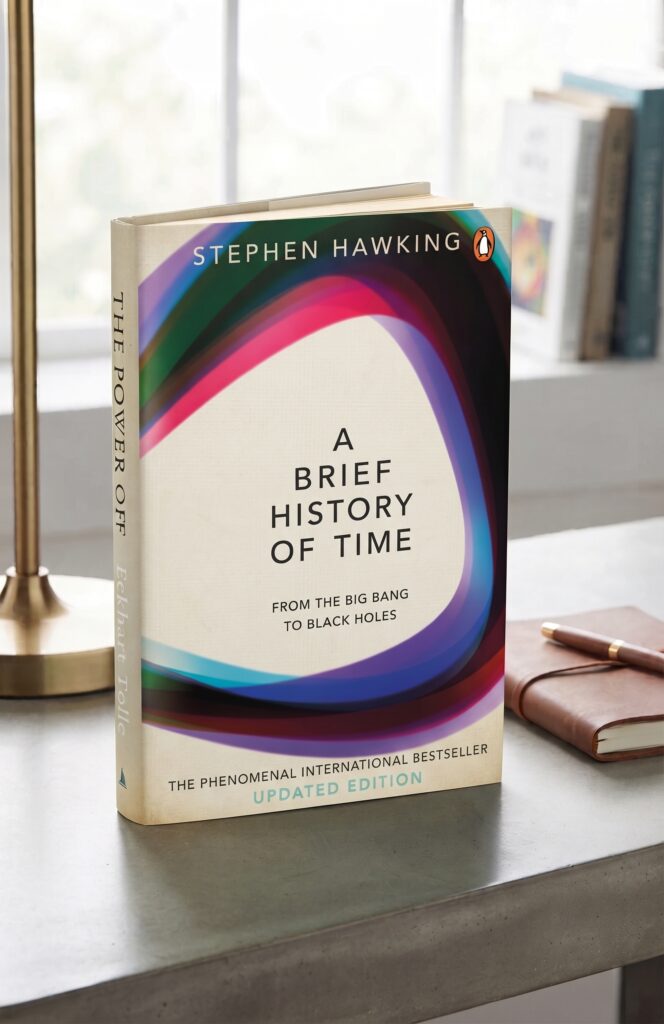
14. A Brief History of Time
By Stephen Hawking
Stephen Hawking’s A Brief History of Time introduces readers to major questions in cosmology and theoretical physics. It discusses the expanding universe, the Big Bang, black holes, the uncertainty principle, elementary particles and the fundamental forces of nature. Hawking also explores the arrow of time, the possible origin and fate of the universe, and the search for a unified description of physical laws. The book aims to make difficult ideas accessible while explaining why these questions challenge ordinary intuition. Scientific understanding has continued to develop since its publication, so it is best read as an influential introduction to the questions and theories of its era rather than as a current physics textbook.
Inside the Book
Chapter 1 — Our Picture of the Universe: Hawking introduces humanity’s changing models of the universe and the role of scientific theories in explaining observations.
Chapter 2 — Space and Time: He traces ideas about space and time from classical physics to relativity and explains why they are linked.
Chapter 3 — The Expanding Universe: The chapter describes evidence that the universe is expanding and considers the Big Bang and possible cosmic histories.
Chapter 4 — The Uncertainty Principle: Hawking introduces quantum uncertainty and its implications for the limits of measurement and prediction.
Chapter 5 — Elementary Particles and the Forces of Nature: He surveys fundamental particles and the forces that govern their interactions.
Chapter 6 — Black Holes: The chapter explains how massive stars can collapse and form regions from which light cannot escape.
Chapter 7 — Black Holes Ain’t So Black: Hawking introduces the quantum effects that lead to the prediction that black holes can emit radiation.
Chapter 8 — The Origin and Fate of the Universe: He considers competing models for the universe’s beginning, expansion and possible future.
Chapter 9 — The Arrow of Time: The chapter explores why time seems to move in one direction and connects this to thermodynamics and the growth of disorder.
Chapter 10 — Wormholes and Time Travel: Hawking considers speculative possibilities involving spacetime geometry and the physical limits on time travel.
Chapter 11 — The Unification of Physics: He discusses the search for a single framework that could bring together the fundamental theories of physics.
Chapter 12 — Conclusion: The closing chapter reflects on the possibility of a complete theory and the human search for an understanding of the universe.
Why it matters: It encourages curiosity about the universe and makes readers more comfortable thinking about scientific questions on a vast scale, from the behaviour of particles to the history of the cosmos.
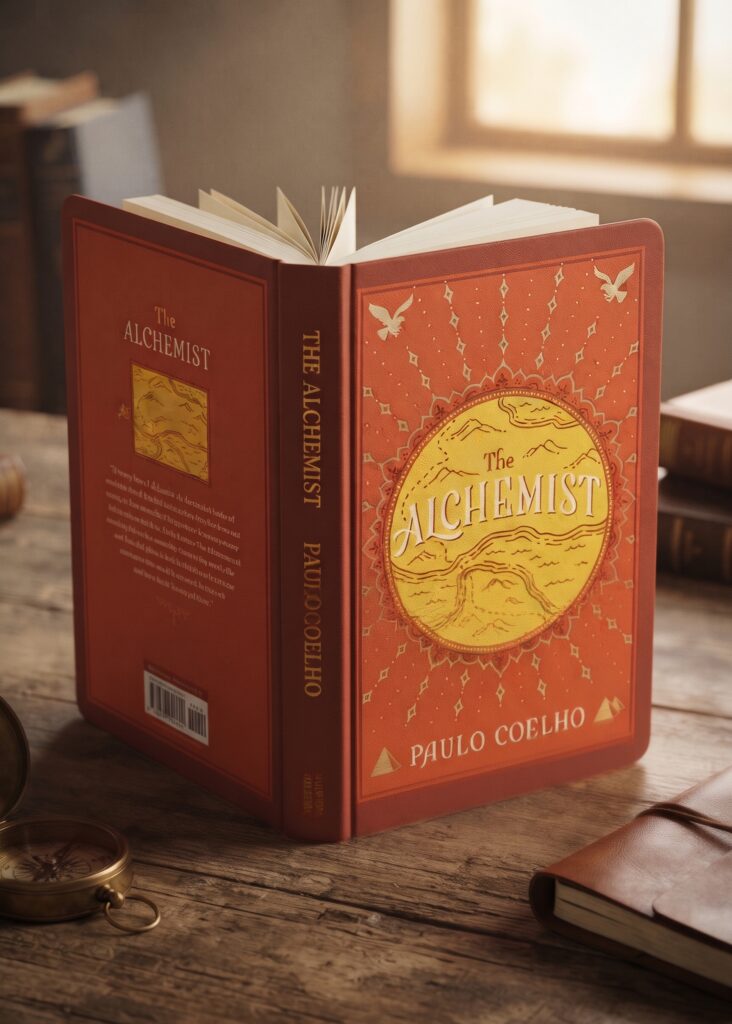
15. The Alchemist
By Paulo Coelho
Paulo Coelho’s philosophical novel follows Santiago, a young shepherd from Andalusia who travels towards Egypt after dreaming of a hidden treasure near the pyramids. During his journey he meets people who influence his understanding of purpose, love, courage and choice. A central idea is the ‘Personal Legend’: the individual calling or purpose that a person is encouraged to recognise and pursue. Santiago learns to pay attention to signs and omens, to persevere through setbacks and to consider how love and personal ambition can coexist. Told as an accessible allegorical tale, the novel invites readers to reflect on the meaning they give to their own journeys. Its spiritual outlook and message about pursuing a purpose will resonate differently with different readers.
Inside the Book
Structure note: The novel is divided into Part One and Part Two, with short unnumbered narrative sections rather than conventional numbered chapters. The section breaks vary in presentation between editions, so the guide follows the two published parts and their main stages.
Part One: Santiago’s recurring dream leads him to a king who introduces the idea of a Personal Legend; he sells his sheep, travels to Tangier, is robbed, and finds work with a crystal merchant. The journey teaches him about setbacks, patience and the choice to continue pursuing his purpose.
Part Two: Santiago joins a caravan across the desert, meets the Englishman and learns from the alchemist; at the oasis he falls in love with Fatima and later faces danger and tests of faith. He reaches the pyramids, discovers the meaning of the treasure’s location and understands how the journey has changed him.
Why it matters: It offers an accessible prompt to think about personal purpose, perseverance and the risks involved in following a meaningful goal, without suggesting that every ambition is guaranteed to succeed.
16. The Naked Ape
By Desmond Morris
In The Naked Ape, zoologist Desmond Morris examines human behaviour through an evolutionary and comparative lens, treating people as animals whose behaviour can be studied alongside that of other species. The book ranges across human origins, sexuality and reproduction, parenting, exploration and curiosity, aggression, feeding, comfort and social behaviour. Morris uses these topics to consider how evolutionary history may have influenced human habits and relationships. The book helped bring popular attention to ethology—the study of animal behaviour—and to evolutionary interpretations of human life. However, some of Morris’s explanations and broad comparisons are debated, and the book reflects the scientific context in which it was written. It is a distinctive perspective on human nature, not a definitive or complete explanation of every aspect of behaviour.

Inside the Book
Chapter 1 — Origins: Morris places humans within the animal kingdom and sketches the evolutionary background of the species he calls the ‘naked ape’.
Chapter 2 — Sex: He examines human courtship, sexual behaviour, pair bonding and reproduction through comparisons with other animals.
Chapter 3 — Rearing: The chapter considers pregnancy, birth, infant care, parental behaviour and the long period of human childhood.
Chapter 4 — Exploration: Morris discusses curiosity, play, learning and the human tendency to investigate unfamiliar environments.
Chapter 5 — Fighting: He examines aggression, dominance, territorial behaviour and the social circumstances in which conflict occurs.
Chapter 6 — Feeding: The chapter looks at food gathering, eating patterns, hunting, food preparation and the social aspects of feeding.
Chapter 7 — Comfort: Morris considers grooming, cleanliness, bodily comfort, rest and other behaviours associated with maintaining the body.
Chapter 8 — Animals: The final chapter considers how humans relate to other animal species, including domestication and the distinctive ways people classify and interact with animals.
Why it matters: It invites readers to consider how biology and evolutionary history may influence behaviour, while encouraging them to question broad claims and distinguish hypotheses from established evidence.
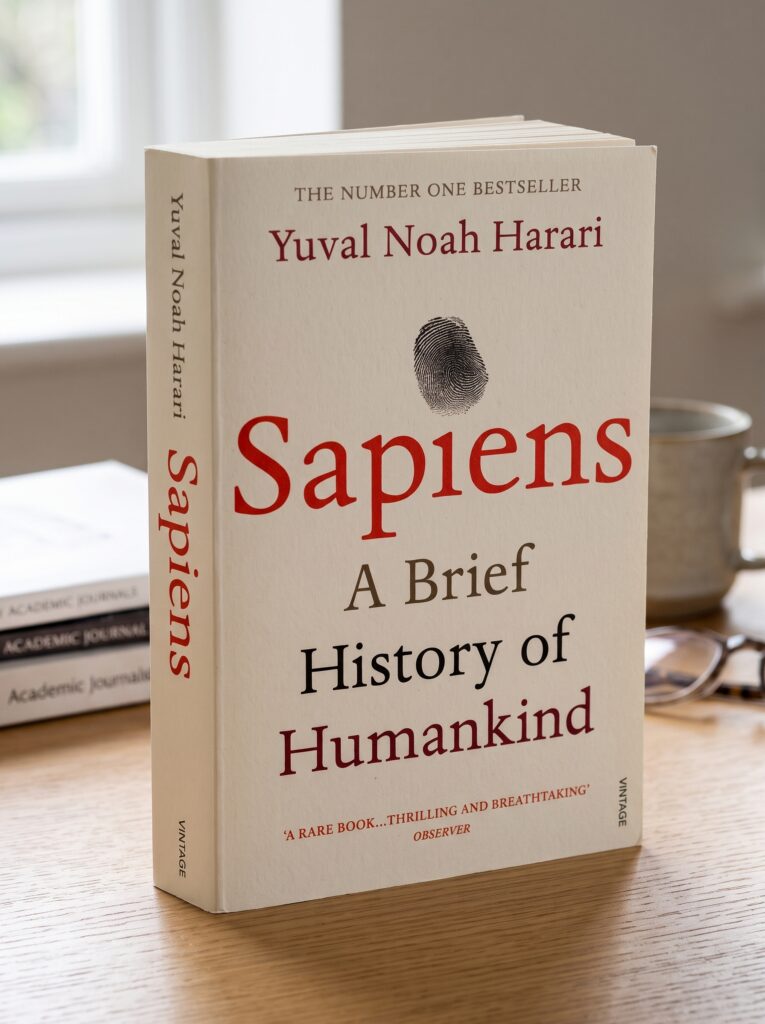
17. Sapiens: A Brief History of Humankind
By Yuval Noah Harari
Yuval Noah Harari’s Sapiens surveys the history of Homo sapiens, from the emergence of our species to the development of agriculture, cities, empires, money and modern institutions. Harari organises his account around four major transitions: the Cognitive Revolution, the Agricultural Revolution, the unification of humankind and the Scientific Revolution. He uses a broad narrative to explore how shared beliefs, stories and systems of cooperation have enabled large groups of people to organise themselves. The book considers religion, trade, empire, technology and the consequences of changing ways of life. It is an ambitious synthesis rather than a specialist textbook; some interpretations and generalisations have been debated by historians and scientists. Readers can gain most from it by treating it as an invitation to explore big questions and follow up on the evidence.
Inside the Book
Part One — The Cognitive Revolution: Chapters 1–4 trace the emergence of Homo sapiens, the development of language and shared imagined realities, everyday life among early humans and the ecological consequences of human expansion.
Chapter 1 — An Animal of No Significance: Harari places early Homo sapiens among other animals and outlines the species’ initially modest position.
Chapter 2 — The Tree of Knowledge: He examines the Cognitive Revolution and the role of language and shared stories in enabling larger-scale cooperation.
Chapter 3 — A Day in the Life of Adam and Eve: The chapter considers the lives of hunter-gatherers and challenges assumptions that prehistoric life was simply primitive or miserable.
Chapter 4 — The Flood: Harari examines the spread of humans beyond Africa and the extinction of many large animal species.
Part Two — The Agricultural Revolution: Chapters 5–8 examine the transition to farming, population growth, new social hierarchies and the institutions that accompanied settled life.
Chapter 5 — History’s Biggest Fraud: Harari argues that agriculture increased food production and population but often made individual lives harder and more constrained.
Chapter 6 — Building Pyramids: He explores how settled societies created large-scale political and religious structures and coordinated mass labour.
Chapter 7 — Memory Overload: The chapter considers how writing, accounting and administrative systems helped societies manage growing amounts of information.
Chapter 8 — There Is No Justice in History: Harari discusses how social hierarchies became embedded in institutions and were often presented as natural or inevitable.
Part Three — The Unification of Humankind: Chapters 9–13 explore the growing integration of human societies through money, empire and religion.
Chapter 9 — The Arrow of History: He considers the long-term movement towards larger and more interconnected cultural and political systems.
Chapter 10 — The Scent of Money: The chapter explains money as a shared system of trust that enables exchange among people who do not know one another.
Chapter 11 — Imperial Visions: Harari examines empire as a major force in political unification, cultural exchange and domination.
Chapter 12 — The Law of Religion: He surveys the role of universal religions and belief systems in organising societies and moral orders.
Chapter 13 — The Secret of Success: The chapter asks why some cultures and empires become dominant and how historical developments shape global arrangements.
Part Four — The Scientific Revolution: Chapters 14–20 consider modern science, capitalism, industrialisation, changing social values and possible futures for Homo sapiens.
Chapter 14 — The Discovery of Ignorance: Harari describes the modern willingness to acknowledge what is not known and to seek new knowledge through research.
Chapter 15 — The Marriage of Science and Empire: He examines the historical links between scientific inquiry, exploration, colonial expansion and state power.
Chapter 16 — The Capitalist Creed: The chapter explores credit, investment, economic growth and the belief that future prosperity can justify present risk.
Chapter 17 — The Wheels of Industry: Harari discusses industrialisation, energy, production and the transformation of daily life.
Chapter 18 — A Permanent Revolution: The chapter examines the pace of modern change and its effects on family, community, politics and the environment.
Chapter 19 — And They Lived Happily Ever After: Harari questions whether modern prosperity and material advances have necessarily made people happier.
Chapter 20 — The End of Homo Sapiens: The book considers biotechnology, artificial intelligence and other developments that could alter or replace familiar forms of human life.
Afterword — The Animal that Became a God: Harari reflects on the power humans have acquired and the unresolved question of what that power should be used for.
Why it matters: It offers a wide-angle perspective on how human societies developed and how shared beliefs, institutions and cooperation shape the world we inhabit.
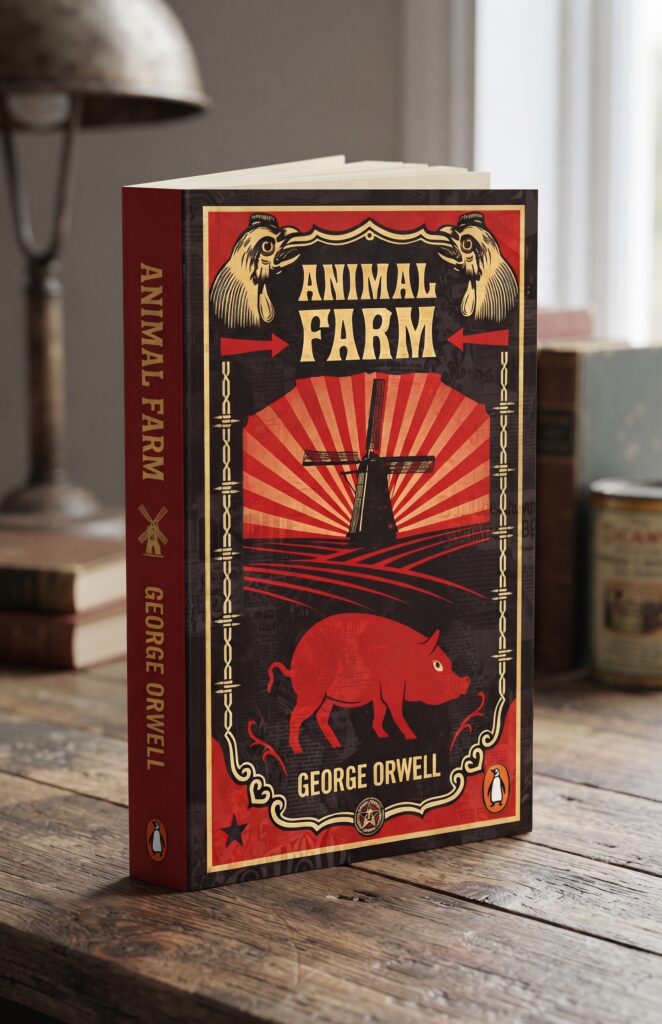
18. Animal Farm
By George Orwell
Animal Farm is a political fable in which farm animals overthrow their human owner in the hope of building a society based on equality. As the pigs take control, the revolution’s ideals are gradually distorted and a new hierarchy emerges. The pigs use propaganda, fear and control of information to maintain authority, while the farm’s original commandments are altered to justify increasingly unequal treatment. Orwell uses the story to examine political manipulation, authoritarianism and the corruption of revolutionary movements. Written in the context of the Russian Revolution and the rise of Stalinism, the novel has a specific historical allegory, but it also works as a broader warning about concentrated power and the betrayal of public ideals.
Inside the Book
Chapter 1: Old Major describes the animals’ exploitation under human ownership and inspires them to imagine a rebellion.
Chapter 2: After Old Major’s death, the animals revolt, drive Mr Jones away and establish Animal Farm and its commandments.
Chapter 3: The animals organise the harvest and begin running the farm, while the pigs gradually claim special privileges.
Chapter 4: News of the rebellion spreads, and the humans attempt to retake the farm but are defeated at the Battle of the Cowshed.
Chapter 5: Disagreements between Snowball and Napoleon culminate in Snowball’s expulsion and Napoleon’s seizure of control.
Chapter 6: The animals work harder, trade with humans and endure the collapse of the windmill, while the pigs revise the rules to justify their conduct.
Chapter 7: Food shortages, forced confessions and executions reveal the growing brutality of Napoleon’s rule.
Chapter 8: Napoleon’s power becomes more extravagant and contradictory, and the windmill is destroyed again during a battle with human neighbours.
Chapter 9: Boxer is injured and later sold to the knacker, while the pigs use propaganda to conceal his fate.
Chapter 10: Years pass, the pigs become indistinguishable from humans, and the animals see that the promised equality has been replaced by a new ruling class.
Why it matters: Its clear allegory helps readers recognise how slogans, misinformation and unchecked authority can undermine equality and freedom.
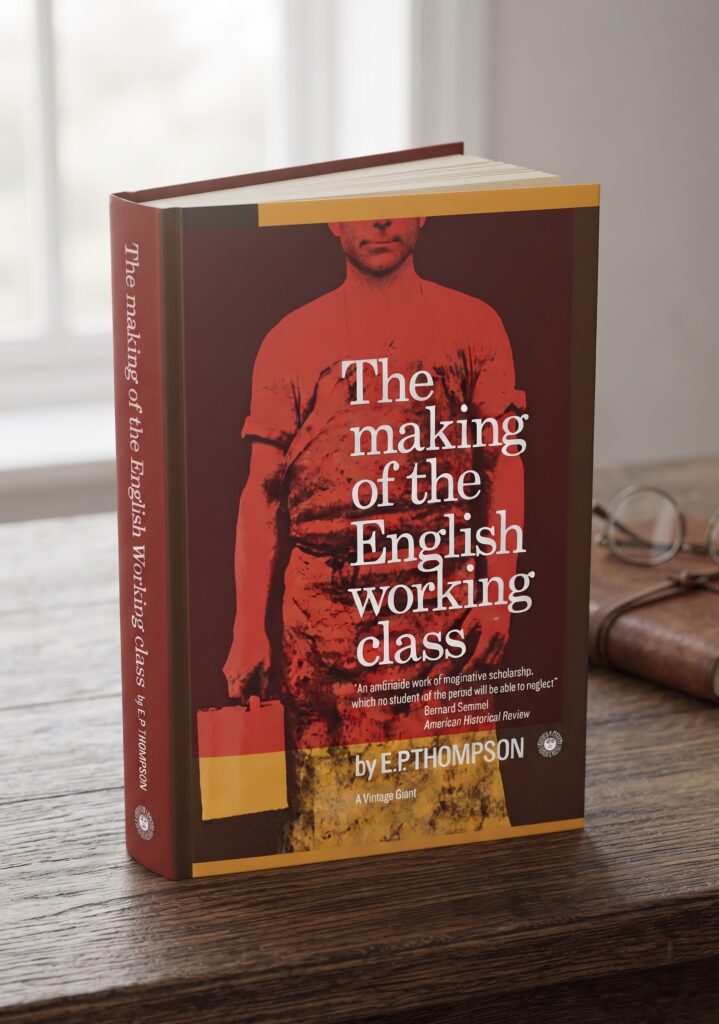
19. The Making of the English Working Class
By E. P. Thompson
Historian E. P. Thompson’s The Making of the English Working Class, published in 1963, explores the experiences, organisations and political culture of working people in England between the late eighteenth and early nineteenth centuries. Thompson argues that the working class was not simply produced by industrialisation or defined by its economic position; it was also formed through shared experiences, relationships, conflicts and collective action. He examines artisans, labourers and other working people, as well as religious movements, radical politics, trade organisations and campaigns for reform. Rather than treating workers as passive recipients of economic change, Thompson shows how people built identities, communities and movements through their own actions. The book became a landmark in social history, although its interpretations and emphasis have also been the subject of scholarly debate.
Inside the Book
Preface: Thompson explains his approach to recovering working people’s experiences and political agency in the making of class.
Part One — The Liberty Tree, Chapter 1: Members Unlimited: He examines the growth of popular political organisation and the emergence of reforming associations.
Chapter 2 — Christian and Apollyon: The chapter explores religious traditions and dissenting beliefs that shaped popular moral and political culture.
Chapter 3 — Satan’s Strongholds: Thompson considers popular religious and political responses to established authority and social change.
Chapter 4 — The Free-born Englishman: He traces traditions of English liberty and the ways ordinary people used them to challenge power.
Chapter 5 — Planting the Liberty Tree: The chapter follows the spread of radical ideas and organisations during the era of revolution.
Part Two — The Curse of Adam, Chapter 6: Exploitation: Thompson analyses the changing experience of work, labour discipline and economic exploitation.
Chapter 7 — The Field Labourers: He examines rural workers, agricultural labour and the pressures placed on those who worked the land.
Chapter 8 — Artisans and Others: The chapter considers skilled trades, workshop life and the social position of artisans.
Chapter 9 — The Weavers: Thompson explores the lives and political experiences of handloom and textile workers.
Chapter 10 — Standards and Experiences: Through goods, homes, daily life and childhood, he investigates how economic change was experienced in ordinary households.
Chapter 11 — The Transforming Power of the Cross: He considers religious movements and the ways evangelical belief shaped discipline, community and working-class experience.
Chapter 12 — Community: The chapter examines leisure, personal relationships, mutual support, Irish communities and popular forms of collective life.
Part Three — The Working-Class Presence, Chapter 13: Radical Westminster: Thompson traces political agitation and the development of organised radical activity in the capital.
Chapter 14 — An Army of Redressers: He examines workers’ associations, combinations and collective campaigns for redress and political change.
Chapter 15 — Demagogues and Martyrs: The chapter follows radical leaders, repression, protest and events including Peterloo and the Cato Street conspiracy.
Chapter 16 — Class Consciousness: Thompson brings together radical culture, political writers and reform movements to explain the emergence of a more coherent working-class identity.
Postscript: Thompson reflects on the book’s argument and its interpretation of class formation.
Why it matters: It highlights the role ordinary people play in shaping history and encourages readers to look beyond the actions of political and social elites to the experiences and collective choices of working communities.
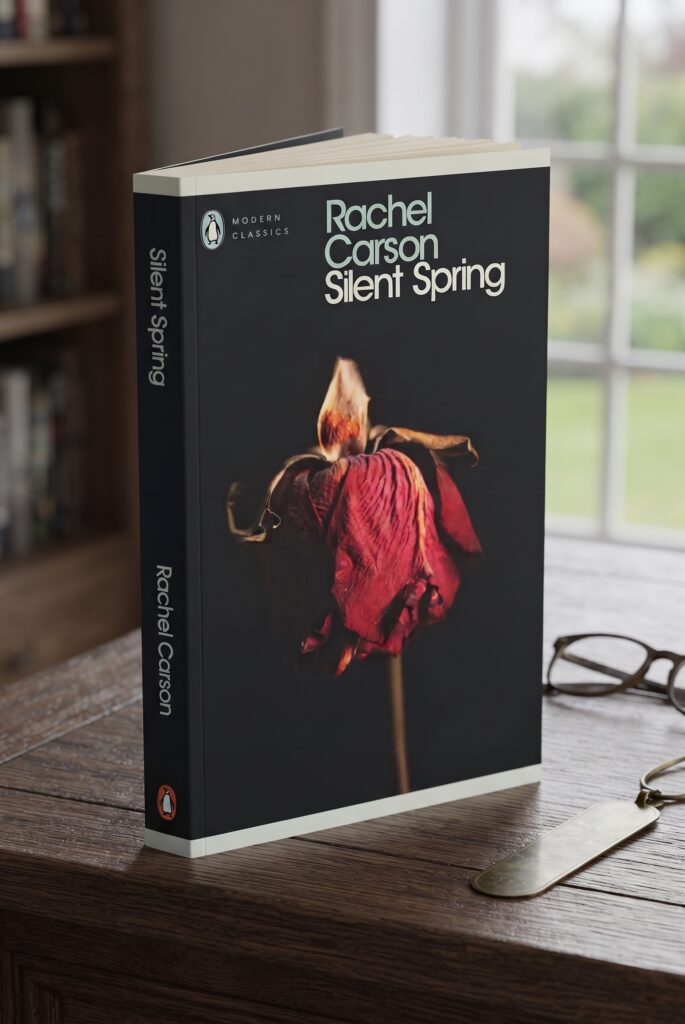
20. Silent Spring
By Rachel Carson
Published in 1962, Rachel Carson’s Silent Spring examines the environmental consequences of indiscriminate pesticide use, with particular attention to chemicals such as DDT and other persistent insecticides. Carson explains how chemicals can move through soil, water and food chains, affecting birds, fish, insects and wider ecosystems. She also raises concerns about possible risks to human health and challenges the assumption that a chemical intervention is safe simply because it targets a particular pest. Combining scientific evidence with clear, compelling writing, Carson questions the ecological costs of widespread chemical control and calls for greater scrutiny, responsibility and more considered approaches to pest management. The book helped stimulate public debate and environmental activism, although it was one influence among many in the development of modern environmental policy and regulation.
Inside the Book
Chapter 1 — A Fable for Tomorrow: A fictional town illustrates how environmental damage could silence wildlife and disrupt ordinary life; Carson explains that the story is based on real incidents.
Chapter 2 — The Obligation to Endure: Carson describes the interdependence of living systems and the scale of chemical contamination introduced into the environment.
Chapter 3 — Elixirs of Death: She examines the toxicity of pesticides and the dangers of treating powerful chemicals as harmless tools.
Chapter 4 — Surface Waters and Underground Seas: The chapter follows pesticide contamination through rivers, lakes, groundwater and aquatic life.
Chapter 5 — Realms of the Soil: Carson explains how chemicals affect soil organisms and the ecological processes that maintain fertile ground.
Chapter 6 — Earth’s Green Mantle: She considers pesticide effects on plants, forests and the wider communities that depend on vegetation.
Chapter 7 — Needless Havoc: The chapter examines broad spraying campaigns and the destruction of non-target species.
Chapter 8 — And No Birds Sing: Carson focuses on the impact of pesticides on birds, including reproductive and population effects.
Chapter 9 — Rivers of Death: She describes chemical pollution in aquatic environments and its consequences for fish and other organisms.
Chapter 10 — Indiscriminately from the Skies: The chapter examines aerial spraying programmes and the difficulty of containing chemicals once they are released.
Chapter 11 — Beyond the Dreams of the Borgias: Carson discusses the development and increasing potency of chemical pesticides and the risks of their widespread use.
Chapter 12 — The Human Price: She turns to evidence and concerns about human exposure, illness and the possible health consequences of pesticides.
Chapter 13 — Through a Narrow Window: The chapter considers how scientific understanding is limited and how ecological complexity can make consequences difficult to predict.
Chapter 14 — One in Every Four: Carson examines cancer concerns and the possible relationship between chemical exposure and disease, reflecting the evidence and debates of her time.
Chapter 15 — Nature Fights Back: She explains how pests can develop resistance and how pesticide use can disrupt natural controls, sometimes creating new problems.
Chapter 16 — The Rumblings of an Avalanche: The chapter considers the cumulative and potentially long-term consequences of chemical contamination.
Chapter 17 — The Other Road: Carson presents alternative approaches to pest control, including biological methods and more ecologically informed management.
Why it matters: It demonstrates the importance of scientific scrutiny and environmental responsibility, and asks who bears the costs when technological interventions disrupt complex natural systems.
21. The Diary of a Young Girl
By Anne Frank
The Diary of a Young Girl contains the writings of Anne Frank, a Jewish teenager who went into hiding with her family and others in Nazi-occupied Amsterdam during the Holocaust. In her diary, Anne records the tensions and routines of life in the Secret Annex, her relationships with the people around her, her hopes and fears, and her reflections on growing up under persecution. Her writing also reveals her developing voice as an observer and aspiring writer, as well as her thoughts about family, identity, friendship and the future. Anne was arrested in 1944 and died in Bergen-Belsen in 1945. The published diary has an important editorial history: Anne rewrote and reorganised much of her own material with publication in mind, and her father Otto Frank later compiled the first published edition using material from her original and revised writings. Different editions may therefore present the diary in different forms. It remains a deeply personal historical document and an important testimony to the human impact of the Holocaust.
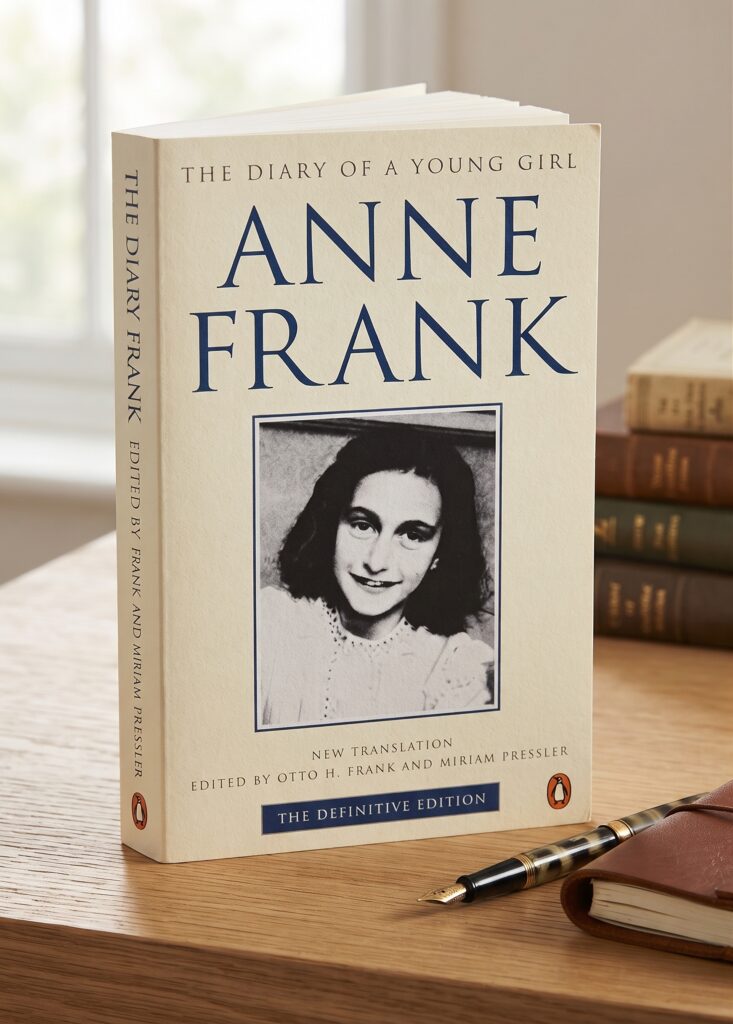
Inside the Book
Structure note: Anne Frank’s diary is not arranged into conventional numbered chapters. Entries are dated and the published text depends on the edition: Anne kept an original diary, later rewrote substantial material herself, and Otto Frank compiled the first published edition from her writings.
12 June–5 December 1942 — First surviving diary book: The earliest surviving notebook begins with Anne’s thirteenth birthday and records school, friends, family life and the increasing danger facing Jewish people in occupied Amsterdam.
22 December 1943–17 April 1944 — First surviving later notebook: After a gap in the surviving manuscripts, Anne’s entries resume during hiding and describe life in the Secret Annex, relationships, fear, daily routines and her changing feelings.
17 April–1 August 1944 — Final surviving diary volume: The final surviving diary entries record the continuing strain of hiding, Anne’s reflections on identity and relationships, her hopes for the future and her development as a writer.
Anne’s rewritten diary — version B: After hearing a radio appeal to preserve wartime accounts, Anne began revising her diary with the intention of possible publication; this version differs from her original entries.
The first published edition — version C: Otto Frank selected and edited material from Anne’s original and revised writings for the first edition after the war; later editions may restore or present additional material.
Why it matters: It gives readers a young person’s perspective on persecution and helps keep the history of the Holocaust connected to individual lives, while also revealing Anne’s development as a writer.
22. The Catcher in the Rye
By J. D. Salinger
J. D. Salinger’s novel follows Holden Caulfield, a teenager who recounts several days of uncertainty and disconnection after leaving his boarding school and spending time in New York City. Holden’s sharp, often unreliable narration reveals his discomfort with adult expectations, social performance and the changes taking place in his own life. His grief over the death of his younger brother Allie and his affection for his sister Phoebe help reveal the vulnerability beneath his cynicism and his desire to protect childhood innocence. The novel explores alienation, grief, identity, loneliness and the difficulty of finding genuine human connection. Its distinctive voice and themes have made it influential, though readers differ widely in how they interpret Holden and his behaviour.
Inside the Book
Chapter 1: Holden introduces the story from a later point and explains that he has left Pencey Prep after failing several subjects.
Chapter 2: He visits Mr Spencer, whose advice about school and the future leaves Holden feeling misunderstood.
Chapter 3: Back in his dormitory, Holden reads and argues with Ackley, revealing his irritation with social habits and pretence.
Chapter 4: Holden talks with Stradlater about his date with Jane Gallagher and becomes increasingly uneasy.
Chapter 5: Holden writes a composition about his deceased brother Allie’s baseball glove, exposing his grief.
Chapter 6: Stradlater criticises the composition, and Holden’s jealousy and anger lead to a fight.
Chapter 7: After the fight, Holden decides to leave Pencey immediately and heads for New York.
Chapter 8: On the train, Holden invents stories about himself while speaking with Ernest Morrow’s mother.
Chapter 9: He arrives in New York, struggles with loneliness and tries to arrange company for the evening.
Chapter 10: Holden goes to the Lavender Room, watches the adults and dances with three tourists.
Chapter 11: He remembers his relationship with Jane and the feelings that make her important to him.
Chapter 12: Holden visits Ernie’s nightclub with a taxi driver’s directions and becomes uncomfortable with the social scene.
Chapter 13: Walking back to his hotel, Holden reflects on fear, sexuality and his own inexperience.
Chapter 14: A confrontation with Maurice and Sunny ends with Holden being beaten and retreating into fantasy.
Chapter 15: Holden meets Sally Hayes for a date and considers calling other people, including Jane.
Chapter 16: He buys a record for Phoebe, walks through the city and tries to find a connection with childhood memories.
Chapter 17: Holden attends a show with Sally, then proposes running away together; the disagreement ends their date badly.
Chapter 18: He thinks about war, entertainment and his younger sister, then arranges to meet a former acquaintance.
Chapter 19: Holden meets Carl Luce in a bar and tries to discuss relationships and sex, but the conversation frustrates him.
Chapter 20: After drinking too much, Holden wanders through the city, breaks the record and visits the park before deciding to see Phoebe.
Chapter 21: Holden sneaks into his family apartment and wakes Phoebe, who quickly realises he has been expelled.
Chapter 22: Phoebe challenges Holden’s criticism of others; he explains his wish to protect children from falling out of innocence.
Chapter 23: Holden talks with Phoebe, speaks briefly with his parents and leaves after arranging to meet her later.
Chapter 24: He visits Mr Antolini, whose advice about education and personal direction unsettles him.
Chapter 25: Holden wanders through the city, becomes distressed and decides to leave; Phoebe arrives with a suitcase and changes his plan.
Chapter 26: From the frame narrative, Holden reflects on the events and hints at his uncertain recovery and return to school.
Why it matters: It encourages reflection on adolescence, emotional isolation, grief and the difficulty of finding an authentic place in the world.
23. The Power of Now
By Eckhart Tolle
Eckhart Tolle’s The Power of Now is a spiritual and self-development book centred on present-moment awareness. Tolle argues that people can become caught in habitual thinking and identify too closely with the mind, memories and imagined futures. He explores the ego, the distinction between thought and awareness, and what he calls the ‘pain-body’, a term for accumulated emotional pain that can shape reactions and relationships. The book also discusses acceptance, surrender, fear, suffering, personal relationships and the possibility of spiritual awakening through presence. Tolle offers reflective exercises and a spiritual framework rather than a clinical or scientific treatment for mental-health conditions. Readers may find its approach useful as a personal practice, while others may prefer different philosophical or practical frameworks.
Inside the Book
Introduction: Tolle describes the personal experience that led him to his teaching and introduces the possibility of a different relationship with thought and awareness.
Chapter 1 — You Are Not Your Mind: He argues that people can observe thoughts rather than identify completely with them, presenting awareness as a route beyond habitual mental activity.
Chapter 2 — Consciousness: The Way Out of Pain: The chapter introduces the pain-body and explores how accumulated emotional pain and ego identification can shape reactions and fear.
Chapter 3 — Moving Deeply into the Now: Tolle distinguishes clock time from psychological time and encourages attention to present experience rather than mental absorption in past and future.
Chapter 4 — Mind Strategies for Avoiding the Now: He identifies ways the mind resists the present through complaint, anticipation, regret and imagined problems.
Chapter 5 — The State of Presence: The chapter describes presence as alert awareness and explores how it changes the way a person experiences ordinary life.
Chapter 6 — The Inner Body: Tolle encourages readers to attend to bodily sensation as a way of anchoring awareness in the present.
Chapter 7 — Portals into the Unmanifested: He explores silence, space, stillness and other experiences that he presents as openings to a deeper spiritual dimension.
Chapter 8 — Enlightened Relationships: The chapter considers how awareness can change intimate relationships, reduce reactive patterns and expose the role of the pain-body.
Chapter 9 — Beyond Happiness and Unhappiness There Is Peace: Tolle discusses impermanence, compassion and the possibility of peace that is not dependent on changing external circumstances.
Chapter 10 — The Meaning of Surrender: The final chapter presents acceptance of the present and surrender to what is, including in the face of illness, suffering and crisis.
Why it matters: It invites readers to notice habitual thought patterns and consider how greater attention to the present might affect everyday life, while recognising that the book presents a spiritual perspective rather than a clinical method.
How to choose where to begin
You do not need to read these books in order, and you do not need to finish every title to benefit from the list. If you prefer storytelling, begin with Pride and Prejudice, To Kill a Mockingbird, The Great Gatsby or The Alchemist. If you are interested in politics and society, consider The Republic, The Communist Manifesto, Orientalism or Animal Farm. For science and the natural world, try On the Origin of Species, Silent Spring or A Brief History of Time. If you are interested in the development of economic and social ideas, The Wealth of Nations and The Making of the English Working Class offer very different historical perspectives. Some works—particularly Kant’s Critique of Pure Reason and Einstein’s The Meaning of Relativity—are demanding and may be easier with a guide or a reading group.
A transformative reading experience is personal. A book that changes one reader’s outlook may leave another unconvinced. Read actively, question the author’s assumptions, compare different perspectives and allow yourself time to think about what you have read.
Conclusion
These 23 books span centuries, cultures and disciplines. Some challenge political and social systems; others explore the natural world, the past, human relationships or the search for personal meaning. They are not a definitive list of the greatest books ever written, but they offer a varied starting point for readers who want to broaden their knowledge and look at familiar questions in new ways. Choose a title that speaks to your curiosity, read with an open but critical mind, and let the ideas stay with you long after you reach the final page.