


Your home should feel like a reflection of who you are. While furniture and colors create the foundation of a room, art and creative decor can add the personality, mood, and character that make a space feel truly yours.
Whether you love peaceful nature scenes, inspirational messages, colorful artwork, minimalist designs, or seasonal themes, the right artwork can transform an ordinary room into a space that feels inviting and personal.
Here are a few simple ways to bring more personality into your home with digital prints, canvas wall art, and creative designs.
Digital prints are one of the most flexible and affordable ways to refresh your home decor. Unlike framed artwork or ready-made wall decorations, a digital print is supplied as a digital file that you can download and print yourself. This gives you more freedom to choose where, how, and at what size you want to display the artwork. You can print the same design in a smaller format for a bedside table or shelf, or choose a larger size for a prominent wall display. Digital artwork can also be especially useful when decorating several rooms because you can select different sizes, frames, and papers while keeping a consistent theme throughout your home.
1. Digital Prints for Flexible Home Decor
Printing Digital Art at Home
One of the easiest options is to print your digital artwork using a home printer. This can be convenient when you only need a small print or want to decorate your home quickly. However, home printers often have limitations on the maximum paper size they can handle. Many everyday home printers are designed primarily for standard sizes such as A4, so you may find that you cannot print a large wall-art design directly at home. Some printers support larger formats such as A3 or A3+, but this depends on the particular printer and the paper-feed system.
If your printer only supports A4, you don’t necessarily have to give up on creating a larger artwork. One practical method is to use a poster or tiled printing option, which divides the larger artwork across several sheets of A4 paper. The individual sheets can then be carefully aligned and assembled to create a larger image. This can work well for temporary decorations, craft projects, or designs that will be placed inside a larger frame. For a professional-looking finished wall print, however, a professional printing service will usually produce a cleaner result, particularly for large artwork.
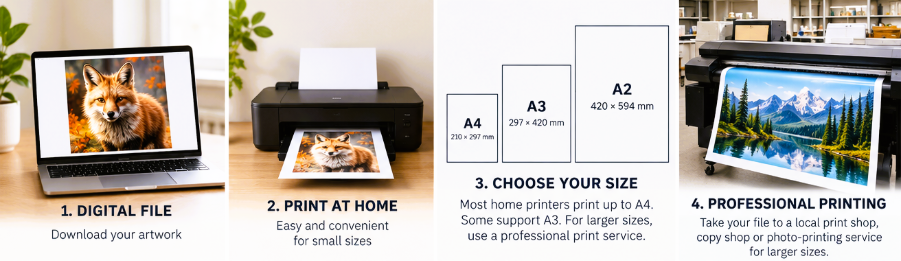
Printing Larger Than A4
When you want a print larger than your home printer can handle, you can save the digital file and take it to a professional print shop, copy shop, photo-printing service, or local stationery/office-printing store. Many of these businesses have larger-format printers capable of printing sizes such as A3, A2, A1, and larger, depending on the equipment available. You can normally provide the digital file on a USB drive or upload it through the printer’s online ordering system if the business offers that service.
Professional printing is particularly useful for artwork intended to become a focal point in a living room, bedroom, hallway, office, or gallery wall. Before ordering, check the print shop’s available paper sizes and ask whether they can print the file at the exact dimensions you want. It is also worth asking whether they offer matte, glossy, satin, or fine-art paper, because the type of paper can significantly affect the appearance of the finished artwork.
Choosing the Right Printing Settings
Your printer settings can make a noticeable difference to the final result. For artwork, check the print dialog before pressing print rather than simply using the default settings. If your printer offers a Best, High Quality, or Photo Quality mode, selecting the higher-quality option can produce more detailed and smoother results. You should also make sure the correct paper type is selected. For example, choosing a photo-paper setting when using photo paper allows the printer to use an appropriate amount of ink and printing process for that material.
Pay attention to paper size, orientation, scaling, and border settings as well. If you want the artwork to fill the paper, look for options such as Fit to Page or Fill Page, but check the preview carefully because some settings can crop parts of the design. If the digital file has a specific aspect ratio, choosing paper with a similar ratio can help you avoid unnecessary cropping or white borders. When available, printing at the highest suitable resolution and using the printer’s recommended quality settings can help produce sharper text, cleaner edges, and better-looking colors.
How to Reduce Printing Costs
Printing at home can be economical, but the cost depends heavily on ink or toner consumption and the type of paper you use. If you’re looking for a lower-cost option, ordinary plain white paper is generally much cheaper than premium photo paper or fine-art paper. Standard printer paper can work well for simple wall prints, especially when the artwork will be placed behind glass or used for temporary decoration. However, inexpensive paper may not have the same thickness, texture, color reproduction, or professional appearance as dedicated art or photo paper.
For a better balance between price and appearance, you can consider medium-weight matte or presentation paper rather than expensive fine-art paper. If you are printing several pieces for a gallery wall, buying paper in larger packs can also reduce the cost per sheet. At professional print shops, it can be worth comparing prices for different paper types and asking whether they offer bulk printing or multiple-print discounts. If you need several copies or several different artworks, ordering them together may sometimes provide a better overall price than purchasing each print separately.
When Professional Printing Is the Better Choice
For larger artwork, high-quality displays, or prints that you want to keep for many years, professional printing can be a better option than trying to assemble multiple A4 sheets at home. A professional printer can often produce a larger continuous print with more consistent color and sharper detail, while also giving you access to a much wider selection of paper sizes and finishes.
The best method therefore depends on your project. Home printing is convenient and economical for smaller artwork and everyday decorating. Tiled A4 printing can provide a way to create larger temporary or DIY displays when your printer cannot handle larger paper. Professional print shops and photo-printing services are better choices when you want larger, more polished artwork or a wider selection of paper and finishing options.
Most importantly, digital prints give you the freedom to choose the approach that fits your space, printer, budget, and desired finish. Whether you print a small inspirational design at home, create a gallery wall from several prints, or order a large professional print for your living room, digital artwork makes it easy to personalize your surroundings without committing to one fixed size or presentation style.
2. Canvas Wall Art for a Finished Look
If you want artwork that becomes a strong focal point, canvas wall art can give a room a finished, welcoming appearance. Unlike a loose paper print, a canvas artwork has a textured surface and can be stretched over a wooden frame or presented with an additional frame, creating a substantial piece of wall decor. Canvas is particularly useful when you want artwork that feels like a permanent part of the room rather than something that can simply be placed in a frame and changed frequently. A large canvas above a sofa, bed, desk, or console table can immediately draw attention and help connect the colors and decorative elements throughout the room.
Different Types of Canvas Wall Art
There are several ways canvas artwork can be produced and displayed. Stretched canvas is one of the most popular choices for home decor. The printed canvas is stretched over a wooden stretcher frame and secured around the back, making it ready to hang. Framed canvas adds another layer of presentation by placing the canvas inside a decorative outer frame, which can create a more traditional, elegant, or contemporary appearance depending on the frame design. Unstretched or rolled canvas is another option, where the printed material is supplied without a wooden frame. This can be useful for people who want to choose their own frame or have a custom framing project. Multi-panel canvas art divides one image across two, three, or more separate panels and can work particularly well on large walls where a single artwork might look too small.
Canvas Materials and Print Quality
The material used for a canvas can affect its appearance, texture, durability, and color reproduction. Cotton canvas is made from natural cotton fibers and is often appreciated for its textured surface and traditional art-like appearance. Polyester canvas is made from synthetic fibers and can provide a smooth, consistent printing surface with strong color reproduction. There are also cotton-polyester blends, which combine characteristics of both materials and are widely used for decorative canvas prints.
When choosing canvas based on quality, it is important to consider more than the material alone. A good-quality canvas should have a suitable weave, a well-prepared printing surface, accurate color reproduction, and good-quality inks. 100% cotton canvas with high-quality, fade-resistant inks is often considered a premium choice for an art-focused or gallery-style appearance because of its natural texture and traditional feel. However, a high-quality polyester or cotton-polyester canvas can also produce excellent results and may offer a practical balance between appearance, durability, and price. The quality of the printing process, ink, stretching, and frame construction can be just as important as the canvas material itself.
Choosing Canvas Wall Art for Different Rooms
The best canvas design depends on the room, its existing colors, the amount of available wall space, and the atmosphere you want to create. In a living room, larger landscapes, mountain scenes, wildlife artwork, colorful illustrations, and inspirational designs can work particularly well. A wide canvas above a sofa can act as the main focal point, while a collection of smaller coordinated canvases can create an attractive gallery arrangement.
For a bedroom, artwork that creates a peaceful and relaxing atmosphere can be a better choice. Softer colors and less visually busy compositions can help the artwork blend naturally with bedding, curtains, and other furnishings. A canvas positioned above the headboard can become a central decorative feature, while two smaller matching pieces on either side of the bed can create a balanced appearance.
A home office or workspace provides an opportunity to choose artwork that reflects motivation, creativity, and personal interests. Inspirational typography, positive messages, landscapes, wildlife, or simple minimalist designs can all work well.
Hallways, entryways, dining areas, and smaller rooms can also benefit from canvas wall art. Hallways often work well with vertical artwork or a series of smaller canvases arranged along the wall. An entryway can feature welcoming artwork that establishes the style of the home as soon as visitors enter. In a dining area, nature, botanical, food-inspired, or colorful artwork can complement the atmosphere without dominating the room. For smaller spaces, avoid choosing artwork that is so large that it overwhelms the available wall area; a smaller canvas or carefully arranged pair can often create a better visual balance.

Choosing the Right Size and Arrangement
The size of your canvas should relate to the size of the wall and the furniture beneath it. A very small canvas above a large sofa can appear disconnected, while an oversized piece can make the wall feel crowded. As a general approach, artwork positioned above furniture often looks more balanced when its overall width is noticeably smaller than the furniture below it. For large empty walls, a larger canvas or multi-panel arrangement can fill the space more effectively than several very small pieces.
Think About the Room Before Choosing the Artwork
Before purchasing or printing canvas wall art, look at the room as a whole. Consider the wall color, furniture, lighting, flooring, curtains, cushions, and other decorative elements. Artwork can either blend with the existing decor or provide contrast, depending on the effect you want. If your room already contains many patterns and strong colors, a simpler canvas may create a more balanced appearance. If the room is mostly neutral, a colorful landscape, wildlife illustration, or inspirational design can become an attractive focal point.
You should also consider the lighting. Artwork displayed in direct sunlight for long periods can be affected by UV exposure over time, so a location away from intense direct sunlight can help preserve its appearance. Excessive moisture can also be unsuitable for many canvas prints, making very humid areas less ideal unless the particular canvas and protective finish are designed for those conditions.
A Simple Change Can Make a Big Difference
You don’t need to completely redecorate a room to give it a new personality. Sometimes one carefully selected canvas can change the entire feeling of a space. Whether you prefer peaceful landscapes for a bedroom, colorful wildlife artwork for a living room, motivational designs for a home office, or a coordinated gallery wall for a hallway, canvas art offers many ways to make your surroundings feel more personal.
The best choice is ultimately the artwork that fits both your space and your personality. Choose the right subject, size, material, and presentation style, and a canvas print can become more than a decoration—it can become one of the defining visual elements of your room.
3. Choosing Artwork That Matches Your Style
The artwork you choose for your home can say a lot about your personality, interests, and the atmosphere you want to create. While decorating trends can provide inspiration, your home doesn’t need to follow a particular trend to look beautiful. The most meaningful artwork is often something that makes you feel good when you look at it. Before choosing a piece, think about the emotions you want to bring into the room. Do you want the space to feel calm and peaceful, energetic and cheerful, inspiring and motivating, elegant and sophisticated, or warm and nostalgic? Once you know the feeling you want, it becomes easier to choose colors, subjects, compositions, and design styles that fit naturally into your space.
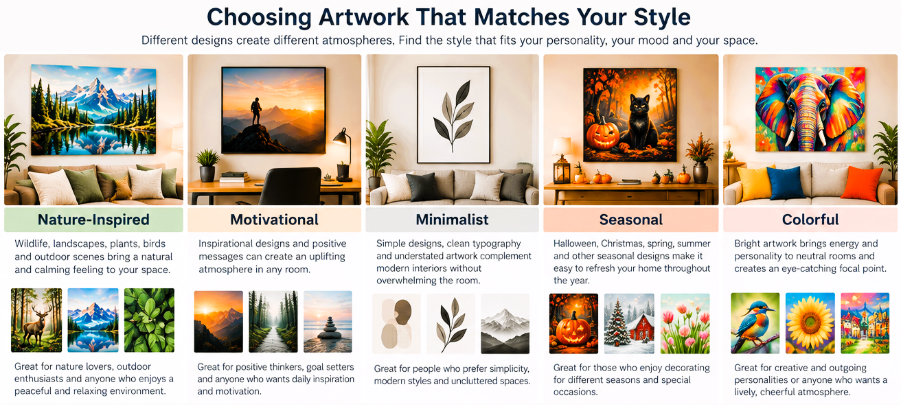
Nature-Inspired Designs for Calm and Nature Lovers
Nature-inspired artwork is a popular choice for people who enjoy the outdoors or want to create a peaceful connection with nature inside their home. Landscapes, forests, mountains, lakes, flowers, birds, and wildlife can bring a natural and relaxing feeling to a room. For example, a person who enjoys hiking and outdoor adventures might prefer a dramatic mountain landscape, while someone who enjoys quiet and peaceful surroundings might choose a misty forest, calm lake, or soft botanical illustration. Wildlife artwork can also add personality—for example, bird artwork can suit someone who loves watching birds, while animal illustrations can reflect an interest in wildlife and the natural world. Designs with greens, blues, earth tones, and other natural colors can work especially well when the goal is to create a calm and comfortable atmosphere.
Motivational Designs for Positive and Ambitious Personalities
Motivational and inspirational artwork can be particularly suitable for people who enjoy positive messages, personal goals, creativity, or self-improvement. Short phrases such as Keep Moving Forward, Follow Your Dreams, Make Today Amazing, or Dream Big can provide a positive reminder throughout the day. These designs can work especially well in home offices, study areas, creative spaces, bedrooms, or workout areas. Someone who enjoys setting goals and staying productive might prefer bold typography with a strong message, while someone who wants a gentle daily reminder may prefer a simple phrase combined with a peaceful landscape or nature illustration. The design doesn’t have to be loud or complicated; sometimes a few carefully chosen words can create a powerful emotional effect.
Minimalist Designs for Simple and Modern Spaces
Minimalist artwork can appeal to people who prefer simplicity, organization, and uncluttered surroundings. Minimalist designs often use clean lines, limited colors, simple shapes, subtle illustrations, or carefully arranged typography. They can be particularly effective in modern homes where you want the artwork to complement the furniture and architecture rather than dominate the entire room. For example, a simple black-and-white botanical illustration might suit a clean bedroom, while understated geometric artwork could complement a contemporary home office. Minimalist artwork can also be useful when a room already contains strong furniture, patterns, or decorative elements because it adds visual interest without making the space feel overcrowded.
Colorful Designs for Energetic and Cheerful Moods
If you want your home to feel bright, energetic, and cheerful, colorful artwork can make a strong difference. Vibrant landscapes, colorful wildlife illustrations, abstract compositions, flowers, birds, and playful designs can bring life to neutral walls and furniture. A person with an outgoing or creative personality might enjoy bold colors and expressive artwork, while someone looking for a simple way to make a quiet room feel more lively could choose one colorful statement piece. For example, a bright bird illustration can bring energy to a neutral hallway, while a colorful landscape can become the focal point of a living room. When using strong colors, consider choosing artwork that includes one or two colors already present in the room so that the design feels connected to the surrounding decor.
Seasonal Artwork for Changing Moods and Occasions
Seasonal designs offer another way to change the feeling of your home throughout the year. Halloween artwork can introduce a playful or spooky atmosphere in autumn, while Christmas designs can create a warm and festive feeling during the holiday season. Spring-themed flowers, summer landscapes, autumn leaves, and winter scenes can also help your decor reflect the time of year. Seasonal artwork doesn’t have to replace your everyday decor completely. You can simply change a few smaller prints or canvases while keeping your main artwork in place. This makes it possible to refresh your surroundings without redecorating an entire room.

Choosing Artwork Based on Your Mood
Your choice of artwork can also change according to how you want to feel, rather than simply matching your personality. If you want to feel relaxed after a busy day, peaceful landscapes, forests, water scenes, botanical artwork, and soft colors may create the atmosphere you’re looking for. If you want to feel energized in the morning, colorful artwork or uplifting messages can provide a more lively visual environment. If you’re working on an important project, motivational artwork can serve as a positive reminder to stay focused. For a cozy and nostalgic feeling, traditional illustrations, familiar seasonal themes, or warm-toned artwork may work particularly well.
Mixing Different Styles to Create a Personal Collection
You don’t have to choose only one design style. Combining different types of artwork can make your home feel more personal and interesting. For example, a gallery wall could combine a nature landscape, a wildlife illustration, a motivational typography print, and a smaller minimalist design. The pieces don’t need to look identical; instead, connect them through a shared color palette, subject, frame style, or overall mood. You might combine several shades of blue and green for a nature-inspired collection, or use black-and-white typography alongside colorful illustrations for contrast.
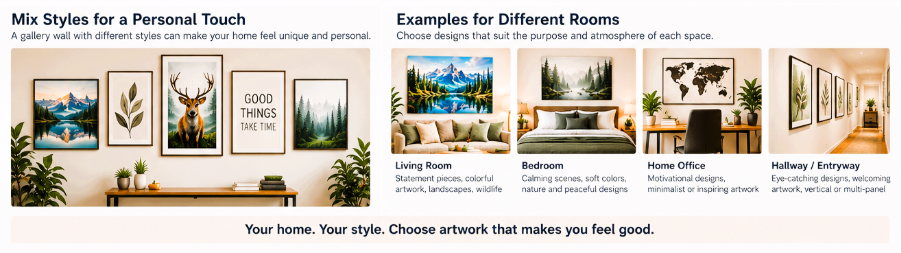
Ultimately, the best artwork is not necessarily the most fashionable or expensive piece—it is the artwork that fits your personality, complements your space, and creates a feeling you enjoy. Whether you are naturally drawn to peaceful nature scenes, ambitious motivational messages, clean minimalist designs, vibrant artwork, or changing seasonal themes, your walls can become a visual expression of what you love and how you want your home to feel. Adding personality to your home doesn’t have to involve a complete makeover. A few thoughtfully chosen pieces can make a meaningful difference.
At Purely Drafted, you can explore a growing collection of canvas wall art designed for different spaces, interests, and occasions, including inspirational, nature, wildlife, and seasonal designs.
Make your space personal with art that tells your story.