

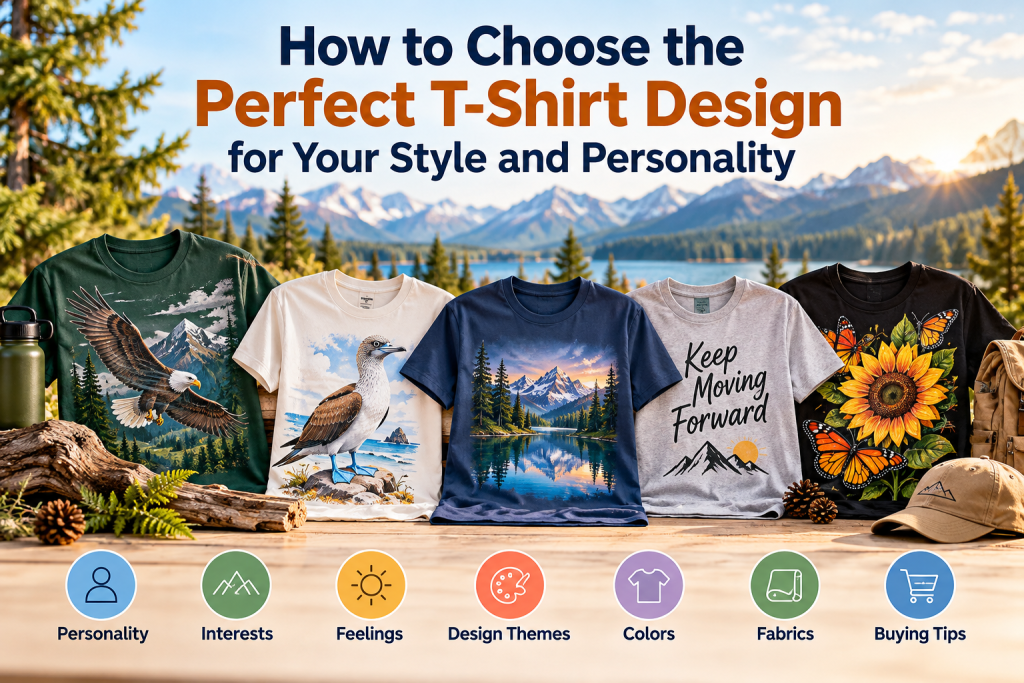
A T-shirt can be more than an everyday piece of clothing—it can be a simple way to express your personality, interests, mood, and creativity. From wildlife and nature artwork to motivational messages, seasonal illustrations, and colorful designs, the right T-shirt can say something about who you are without saying a word.
When choosing a T-shirt design, think about what you enjoy, what inspires you, and what kind of style feels natural to you. Whether you prefer bold artwork, meaningful messages, or playful illustrations, there is a design to suit almost every personality.
1. Find a T-Shirt Design That Reflects Your Personality
The best T-shirt designs often have a personal connection. Instead of choosing an image simply because it looks attractive, consider what the artwork represents to you. Your interests, personality, mood, and the way you want to express yourself can all influence the designs and colors you are naturally drawn to.
Psychology research suggests that clothing can have psychological meaning for the person wearing it. The concept of “enclothed cognition,” introduced by psychologists Hajo Adam and Adam Galinsky, proposes that clothing can influence psychological processes through both the symbolic meaning we attach to what we wear and the physical experience of wearing it. In other words, a T-shirt can be more than decoration—it can help reinforce how you want to feel or present yourself.
Your Personality Can Influence the Designs You Prefer
People have different ways of expressing themselves, so there is no single T-shirt style that is right for everyone.
Extroverted and Energetic Personalities
People who are naturally outgoing and enjoy social interaction may be attracted to designs that are noticeable, expressive, humorous, or visually energetic.
Try:
- Bold wildlife illustrations
- Large eagle or animal artwork
- Bright, colorful illustrations
- Strong motivational statements
- High-contrast graphics
- Eye-catching seasonal designs
Interestingly, research has found an association between extraversion and preference for higher-chroma colors—colors that are more vivid and intense. Other experiments found that people wearing or surrounded by more colorful designs were perceived as more extraverted and open. This doesn’t mean that every extrovert prefers bright colors, but it suggests that color intensity can play a role in how personality is expressed and perceived.
For someone who enjoys standing out, a vivid eagle flying across a mountain landscape or a colorful wildlife illustration could therefore be a natural choice.
Introverted and Reflective Personalities
Introversion is not the same as being shy or lacking confidence. As Susan Cain discusses in Quiet: The Power of Introverts in a World That Can’t Stop Talking, introverted people may prefer listening, reflection, independent activities, and environments that allow them to recharge.
For someone with a quieter or more reflective personality, a T-shirt with a meaningful but understated design may feel more natural than a very loud graphic.
Consider:
- Peaceful landscapes
- Birds and wildlife
- Mountains and forests
- Minimalist artwork
- Subtle inspirational messages
- Earth tones and softer colors
- Simple line or nature-inspired designs
A calm mountain landscape, a solitary bird, or a simple phrase such as “Keep Moving Forward” can communicate something meaningful without demanding attention.
Of course, introverts can love bold designs too. Personality should be a source of inspiration, not a rulebook.
Calm, Spiritual, and Contemplative Personalities
Some people are naturally drawn to quiet environments, reflection, mindfulness, spirituality, or a sense of connection with nature.
For these individuals, designs inspired by peace, nature, balance, and contemplation may feel particularly appropriate.
Good choices might include:
- Forests and mountains
- Lakes and peaceful landscapes
- Birds in flight
- Sunrises and sunsets
- Botanical artwork
- Soft blue, green, beige, or earth-tone palettes
- Simple messages about peace, gratitude, dreams, or personal growth
Nature-inspired artwork can be especially meaningful for someone who associates certain landscapes or outdoor experiences with peace, calmness, or positive memories. A peaceful landscape may remind someone of a favorite place, while a sunrise, flying bird, or colorful nature scene can represent hope, freedom, renewal, or a fresh start.
For someone going through a difficult or demanding period, a T-shirt can also be chosen as a personal reminder of something positive or meaningful. Designs such as these may create that feeling:
- A sunrise over mountains
- A bird flying toward an open sky
- Green forests or peaceful landscapes
- Colorful flowers
- Positive phrases such as “Keep Moving Forward,” “Follow Your Dreams,” or “Make Today Amazing”
- Artwork associated with a favorite place or happy memory
The purpose is not to suggest that a T-shirt can change someone’s mental or emotional condition. Rather, the design can represent hope, resilience, nature, positive memories, or something personally meaningful.
Creative and Open-Minded Personalities
People who enjoy creativity, art, experimentation, and new experiences may naturally gravitate toward unusual compositions, imaginative illustrations, and expressive color combinations.
Try:
- Artistic animal illustrations
- Surreal or imaginative artwork
- Unusual color combinations
- Colorful wildlife
- Creative typography
- Artistic nature scenes
Research on personality and color has found relationships between traits such as Openness and preferences involving color characteristics, although these relationships are not strong enough to use color as a personality test.
Adventurous Personalities
For people who love travel, exploration, outdoor activities, and new experiences, artwork can reflect a sense of movement and freedom.
Consider:
- Flying eagles
- Mountains
- Forests
- Ocean scenes
- Wildlife
- Adventure-inspired landscapes
- Inspirational phrases
A flying eagle, for example, can visually communicate ideas such as freedom, independence, strength, and exploration. The meaning ultimately comes from the viewer, but that personal interpretation is part of what makes graphic T-shirts interesting.
Color Psychology: Can Your T-Shirt Color Reflect Your Personality?
Color is one of the most noticeable elements of a T-shirt, but psychology does not support a simple dictionary where every color has one fixed personality meaning.
A major review by psychologists Andrew Elliot and Markus Maier found that color can influence affect, cognition, and behavior, but also emphasized that the scientific literature is still developing and that context, culture, individual differences, and the specific situation matter.
This means that instead of saying “blue means introvert” or “red means extrovert,” it is better to think about colors as visual tools that can create different impressions.
Blue — Calm, Peaceful, and Reflective
Blue is often associated with calmness, openness, trust, water, and sky. For a peaceful or reflective T-shirt, consider:
- Ocean scenes
- Blue-footed booby artwork
- Blue mountain landscapes
- Birds against a blue sky
- Simple blue typography
Blue and green hues have also been associated with lower psychological arousal in color-emotion research, although the relationship is influenced by saturation, brightness, and context.
Green — Nature, Balance, and Renewal
Green naturally connects with forests, plants, landscapes, and outdoor environments.
It can work particularly well for:
- Nature lovers
- Outdoor enthusiasts
- Wildlife designs
- Botanical artwork
- Peaceful landscapes
A green T-shirt featuring an eagle, forest, or mountain scene can create a strong connection between the color and the subject of the artwork.
Yellow and Orange — Brightness and Energy
Yellow and orange can create a visually energetic and cheerful appearance, especially when used with high brightness or saturation.
They can work well for:
- Sunflowers
- Sunsets
- Summer artwork
- Cheerful illustrations
- Fun seasonal designs
However, color-emotion associations are not universal. Research has found that people can associate colors with emotions, but specific one-to-one color/emotion pairings are often inconsistent.
Red — Attention and Energy
Red can be visually powerful and attention-grabbing. High-saturation red is associated with higher arousal in some research, although color effects depend heavily on context and other properties such as brightness and saturation.
Red can therefore work well as an accent in:
- Motivational designs
- Strong typography
- Athletic or adventurous artwork
- Holiday designs
- Bold wildlife illustrations
Rather than covering an entire design in red, using it as an accent can create emphasis while allowing the artwork to remain balanced.
Earth Tones — Natural and Understated
Brown, beige, muted green, and other earthy colors can work particularly well with:
- Wildlife
- Mountains
- Forests
- Birds
- Outdoor scenes
- Minimalist artwork
Older research has sometimes found relationships between introversion and preferences for tertiary or achromatic colors, but these findings are not universal, and later research has produced mixed results.
So earth tones can be a style suggestion, not a psychological label.
Choose a Design That Matches How You Want to Feel
One of the most interesting ways to think about T-shirt psychology is not simply:
“What color matches my personality?”
Instead, ask:
“How do I want this T-shirt to make me feel?”
Someone who is naturally quiet might occasionally choose a bright, adventurous eagle because they want to feel more energetic and confident.
Someone who is normally outgoing might choose a peaceful mountain or forest design because they want something calming.
Someone going through a difficult period might choose a colorful nature design because it reminds them of a favorite place, while another person might prefer a simple motivational message.
Clothing therefore doesn’t have to represent only who you are now. It can also represent what inspires you, what you value, or how you want to express yourself.
The Best Design Is the One That Feels Like You
Psychology can provide interesting clues about personality, color, emotion, and visual preferences, but there is no universal formula for choosing the perfect T-shirt.
Your personal memories, culture, lifestyle, favorite colors, interests, and individual experiences all matter. A nature lover may choose a peaceful bird design, an adventurous person may prefer a flying eagle, while someone who loves positive messages may choose an inspirational phrase.
The most meaningful T-shirt is ultimately the one that connects with you.
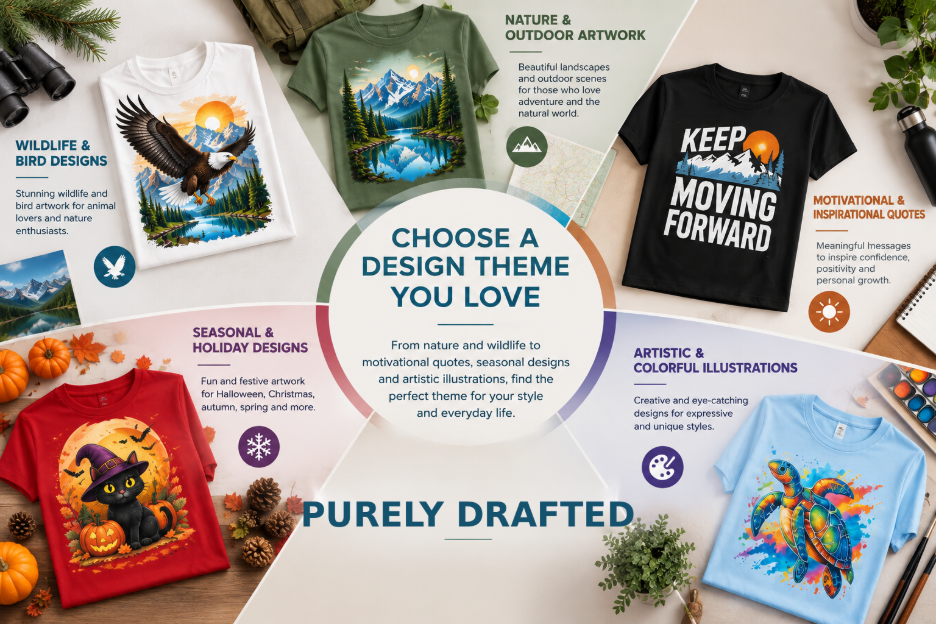
2. Choose a Design Theme You Love
Once you have considered your personality and the subjects you enjoy, think about the feeling you want your T-shirt to express.
Ask yourself three simple questions:
1. What is my personality?
Are you adventurous, calm, outgoing, reflective, creative, playful, or somewhere in between?
2. What are my interests?
Do you love wildlife, birds, nature, travel, outdoor activities, art, inspirational ideas, or seasonal celebrations?
3. What feeling do I want the design to express?
Do you want something energetic, confident, peaceful, optimistic, adventurous, creative, or cheerful?
These questions can help you move from simply choosing an attractive picture to choosing a design that has personal meaning.
Wildlife & Bird Designs
Wildlife and bird artwork can be a natural choice for people who feel connected to animals, nature, freedom, or the outdoors.
Eagles, colorful birds, and other wildlife can create distinctive T-shirt designs while expressing an appreciation for the natural world.
A flying eagle, for example, can be interpreted as representing ideas such as freedom, strength, independence, confidence, and adventure. If those ideas appeal to you, an eagle design may feel more personally meaningful than a generic graphic.
Bird designs can also work for people who appreciate peaceful natural imagery. A bird overlooking a landscape, for example, can combine an interest in wildlife with a feeling of openness and calm.
Nature & Outdoor Artwork
Nature-inspired T-shirts are ideal for people who feel connected to the outdoors or simply enjoy the visual calm of natural landscapes.
Mountains, lakes, forests, beaches, birds, and outdoor scenes can bring an adventurous or peaceful quality to everyday clothing.
These designs can be particularly appealing to people who enjoy:
- Hiking and walking
- Traveling and exploring
- Photography
- Camping and outdoor activities
- Wildlife
- Landscapes and natural scenery
A mountain-and-lake design might appeal to someone looking for a feeling of adventure and exploration, while a quiet forest or peaceful lake may better suit someone looking for calm and reflection.
This is also where your first three questions work together: the same nature theme can serve very different people depending on the personality and feeling they want to emphasize.
Motivational & Inspirational Quotes
Sometimes the most meaningful T-shirt design is a few simple words.
Motivational designs can communicate ideas such as confidence, perseverance, hope, ambition, personal growth, and resilience.
Someone who is highly goal-oriented might choose a strong motivational statement because it reflects an important part of their personality. Another person may choose the same design because the message represents the feeling they want to reinforce during a difficult or demanding period.
For example:
- “Keep Moving Forward” → perseverance and progress
- “Follow Your Dreams” → ambition and optimism
- “Make Today Amazing” → positivity and energy
- “Trust Your Wings” → confidence and independence
The meaning behind a phrase can make the design personally significant to the person wearing it.
Seasonal & Holiday Designs
Seasonal artwork gives you another way to express your personality and interests.
Halloween, Christmas, autumn, spring, summer, and other seasonal themes can change the feeling of an outfit throughout the year.
For someone who enjoys fun and social occasions, a colorful Halloween or Christmas design can express a playful side. Someone who loves autumn might prefer woodland animals, pumpkins, leaves, or warm seasonal colors.
Seasonal T-shirts can also be meaningful as gifts because the design can connect the recipient with a particular holiday, tradition, interest, or favorite time of year.
Artistic & Colorful Illustrations
If you enjoy creativity, experimentation, and expressive artwork, colorful illustrations can be a natural choice.
Artistic animals, colorful birds, imaginative compositions, and vibrant nature scenes can make a simple T-shirt feel more distinctive.
Color can also influence the choice. Research suggests that color preference is related to several factors, including personality, mood, culture, identity, and the particular object being viewed. A recent study, for example, found that personality traits including openness and extraversion were relevant to preferences for color saturation, while also finding that preferences depended strongly on the type of object and color combination.
Another study found that people higher in extraversion showed a greater preference for high-chroma, more vivid colors. This does not mean that every extrovert should wear bright colors, but it provides an interesting example of how personality and color preference can be connected.
This gives you another useful question to ask:
Do I want my T-shirt to blend with my personality, or express a feeling I want more of today?
Someone who normally prefers understated clothing might occasionally choose a vivid design because they want something energetic and expressive. Likewise, someone who usually wears bold colors might choose a peaceful nature design when they want something more relaxed.
A Simple Way to Choose Your Design
You can bring the three ideas together in a simple formula:
PERSONALITY + INTEREST + FEELING → DESIGN
For example:
Adventurous personality + love of wildlife + desire for confidence
→ Flying eagle design
Nature lover + enjoys mountains + wants a peaceful feeling
→ Mountain and lake design
Goal-oriented personality + enjoys inspirational messages + wants motivation
→ “Keep Moving Forward”
Creative personality + loves colorful artwork + wants an energetic feeling
→ Colorful wildlife or artistic illustration
Animal lover + enjoys seasonal celebrations + wants a playful feeling
→ Seasonal wildlife design
The goal is not to follow a strict formula, but to find a design that feels personally meaningful to you.
You don’t have to stick to just one style; your taste can shift depending on your mood, the season, or the occasion. One day you might choose an inspiring design, while the next you might prefer a colorful wildlife illustration—that’s the fun part of wearing graphic T-shirts. However, if you want to cultivate a specific feeling within yourself, try wearing T-shirts and outfits featuring related designs for a few weeks or months.
3. Choose the Right Fabric: Comfort, Quality and How It Feels
Choosing a T-shirt is not only about the artwork, color, or message. The fabric itself becomes part of the wearing experience. A design may look fantastic, but if the shirt feels rough, stiff, too hot, or uncomfortable against the skin, you may be less likely to wear it.
Fabric choice also has a subtle psychological dimension. Clothing comfort involves physical, sensory, physiological, and psychological perceptions, while research on textile touch shows that properties such as friction, roughness, stiffness, dryness, and temperature can influence how comfortable and pleasant a fabric feels.
Natural, Synthetic and Blended Fabrics
T-shirt fabrics can broadly be divided into natural fibers, manufactured/synthetic fibers, and blends.
Natural fibers come from plants or animals. Cotton is the most common natural fiber for everyday T-shirts, while linen, wool and silk are also traditional textile fibers, although they are much less common in standard T-shirts.
Manufactured fibers are produced through industrial chemical and mechanical processes. Polyester is one of the most common examples in clothing. Other manufactured or regenerated fibers include rayon, viscose and modal.
Blended fabrics combine two or more fibers to balance their properties—for example, cotton and polyester. Blends are widely used because they can combine cotton’s familiar softness with polyester’s durability and shape retention.
How T-Shirt Fabric Is Made
The manufacturing process begins with the fiber rather than the finished T-shirt.
For cotton, harvested fibers are cleaned and prepared before being spun into yarn. Different spinning techniques affect the resulting yarn. Ring-spun cotton uses a spinning process that produces a finer, smoother yarn, while combing removes shorter fibers before spinning, creating an even smoother and more refined material.
The yarn is then knitted into fabric. Most T-shirts use knitted rather than woven fabric because knitted construction provides the flexibility and stretch needed for comfortable everyday clothing.
After knitting, the fabric can undergo processes such as dyeing, finishing and softening before being cut and sewn into garments. Finishing treatments can significantly influence the surface sensation of a textile, including its smoothness and softness.
Synthetic fabrics follow a different route. Polyester is manufactured from chemical polymers that are formed into fibers and then spun or processed into yarn. The resulting fabric can be engineered for properties such as durability, shape retention, quick drying and moisture management.
The Most Common T-Shirt Fabrics
| Fabric | Feel against skin | Main strengths | Common use |
| 100% Cotton | Natural, soft, familiar | Breathability, comfort, easy everyday wear | Casual T-shirts |
| Combed Ring-Spun Cotton | Very smooth and soft | Premium feel, good print surface | Higher-quality retail T-shirts |
| Polyester | Smooth or slightly technical | Durable, quick-drying, shape retention | Sports and performance wear |
| Cotton-Polyester Blend | Balanced and comfortable | Comfort + durability | Everyday, uniforms and merchandise |
| Tri-Blend | Very soft, lightweight, drapey | Softness and fashion-oriented appearance | Premium casual apparel |
| Modal/Rayon Blends | Very smooth and soft | Soft drape and comfortable hand feel | Fashion-oriented lightweight clothing |
Cotton, polyester and cotton-polyester blends dominate the T-shirt market, while fabrics such as tri-blends, modal and linen provide alternative characteristics.
Which Fabric Is Best for a High-Quality T-Shirt?
There is no single fabric that is best for every person or every purpose. The ideal fabric depends on how the T-shirt will be worn.
For a premium everyday T-shirt, however, 100% combed ring-spun cotton is one of the strongest choices. It combines a smooth, soft feel with good breathability and a relatively even surface that works well for detailed printing. Current apparel guides commonly identify combed ring-spun cotton as a strong balance of softness, durability, printability and everyday comfort.
For sports and highly active use, polyester can be more appropriate because it dries quickly and is designed for moisture management. For someone wanting a balance between comfort and durability, a cotton-polyester blend can be an excellent compromise.
So rather than asking “Which fabric is the best?”, a better question is:
“Which fabric is best for the way I want to feel and use this T-shirt?”
The Sensory Experience: How Does the Fabric Feel?
We often make a fabric judgment within seconds of touching it. Is it smooth or rough? Soft or stiff? Lightweight or substantial? Cool or warm? Does it glide across the skin or create friction?
These sensations are not imaginary. Research into skin–textile interaction shows that friction and tactile stimulation can influence perceptions such as roughness, stiffness, dryness, thermal sensation, comfort and preference. Different parts of the body can also vary in tactile sensitivity, with the neck being particularly sensitive to skin–fabric friction.
This helps explain why two T-shirts made from similar materials can still feel noticeably different. Fiber type, yarn construction, fabric weight, knitting structure, finishing and surface texture can all contribute to the final sensation.
A basic cotton T-shirt may feel familiar and natural, while combed ring-spun cotton can feel smoother and more refined. Polyester may feel sleek and technical, which some people appreciate for activewear but others may find less natural. A lightweight tri-blend can feel exceptionally soft and drapey.
The Psychology Behind Fabric Selection
Fabric selection is not purely a technical decision. What feels comfortable can influence how we perceive the clothing and how willing we are to wear it repeatedly.
Clothing comfort research recognizes psychological as well as physical and physiological dimensions of comfort. Our expectations, previous experiences, personal preferences and the situation in which clothing is worn can therefore influence whether a particular material feels right to us.
This connects naturally with the personality and mood considerations discussed earlier in this article.
Someone who values relaxation and comfort may gravitate toward soft, breathable cotton. Someone who enjoys sports and an active lifestyle may prefer lightweight performance polyester. Someone interested in a fashionable, soft, relaxed appearance might enjoy a lightweight tri-blend.
There is also an interesting sensory component: laboratory research has found that the brain can distinguish between different textile qualities during fabric–skin contact, with different fabrics producing different neural responses and preference-related reactions.
This does not mean that a particular fabric will automatically improve someone’s mood or reveal their personality. Instead, it suggests that our sensory experience of clothing can become part of our personal preferences and the way we experience what we wear.
Think About Fabric as Part of Your Personal Style
When choosing your next T-shirt, consider these four questions:
1. What is my personality?
Do I prefer relaxed, adventurous, expressive, minimalist or practical styles?
2. What are my interests?
Do I connect with wildlife, nature, travel, sports, art, seasonal themes or motivational messages?
3. What feeling do I want the design to enhance?
Do I want something that feels energetic, positive, peaceful, confident, playful or simply comfortable?
4. How do I want the T-shirt to feel against my skin?
Do I prefer natural softness, a smooth technical feel, lightweight drape or a more substantial fabric?
When these four choices come together, the T-shirt becomes more than a printed garment. The artwork expresses what you like, while the fabric determines much of how the garment feels to live in.
For a high-quality everyday T-shirt, a soft, well-constructed cotton fabric—particularly combed ring-spun cotton—is an excellent starting point, while polyester and blends may be better choices when performance, durability or specific sensory preferences are more important.
This makes fabric another important part of finding a T-shirt that feels right for you—not only visually, but physically and personally.
4. What Matters Most When Buying a T-Shirt—and Finding the Right One for You
After considering personality, interests, design themes, fabric, comfort and quality, one final question remains: what actually matters most to shoppers when they decide to buy a T-shirt?
Design, Quality or Price: What Do Shoppers Really Prioritize?
There is no single factor that determines every T-shirt purchase. Design can attract attention, but shoppers also consider comfort, quality, material, durability and price when evaluating clothing.
A 2023 VistaPrint UK study of personalised T-shirt trends found that 58% of respondents identified a great design as a main driver for buying branded T-shirts, followed by 45% who mentioned good quality and 41% who mentioned good pricing. This suggests that, particularly for graphic and personalised T-shirts, the artwork can be an important factor in attracting shoppers.
A large apparel-shopping study found that 86% of clothing shoppers considered comfort when purchasing clothing, while 78% considered overall product quality, 66% considered material and 58% considered durability. Price information was also important, with 83% of shoppers looking for pricing information when deciding whether to purchase clothing.
Research specifically examining T-shirt purchasing has also found that price, quality and brand or label were among the factors consumers considered, with price at 31%, quality at 30% and brand/label at 21%.
These findings highlight an important point: the design may be what first catches someone’s attention, but comfort, quality, material, fit and price can all influence the final purchasing decision.
A T-Shirt Is More Than Its Artwork
The right T-shirt brings together more than an attractive design. It combines the artwork you connect with, the interests you enjoy, the feeling you want to express, and the comfort and quality you expect from the garment.
The best choice is ultimately one that looks right, feels right, and feels like you.
Quality T-Shirts at Purely Drafted Store
We also offer T-shirts using two popular blank styles: Gildan and BELLA+CANVAS fabric brands, giving shoppers a choice between different fabric weights and wearing experiences.
At Purely Drafted, we offer a growing selection of original T-shirt designs created around different personalities, interests and occasions. Our collection includes wildlife and bird artwork, nature and outdoor themes, motivational and inspirational messages, colorful illustrations, seasonal designs and other creative graphic artwork.
The Gildan 5000 Heavy Cotton™ is a classic, substantial everyday T-shirt made from 5.3 oz/yd² cotton, with the standard core fabric listed as 100% U.S. cotton; Gildan notes that fiber content can vary by color. Its classic construction, taped neck and shoulders, and double-needle details make it a practical choice for everyday wear.
The BELLA+CANVAS 3001 offers a lighter, more premium-feeling alternative. It uses 100% Airlume combed and ring-spun cotton, 32 singles and 4.2 oz, with a side-seamed construction and a smooth surface designed for printing. The combing and ring-spinning process helps produce the soft, smooth feel associated with this style.
This gives you two different approaches to everyday T-shirt comfort: the more substantial, classic feel of the Gildan 5000 and the lighter, exceptionally soft feel of the BELLA+CANVAS 3001.
Whether you are looking for a shirt that reflects your love of wildlife, your connection with nature, your positive mindset, your creative personality, or a particular seasonal occasion, Purely Drafted is designed to give you more than just a T-shirt— you can find artwork that represents something you enjoy and want to express.
Choose the design that speaks to you. Choose the fabric that feels right. And choose a T-shirt that feels like you.
Some references used in preparing the blog include:
1. H. Adam and A. D. Galinsky, Enclothed cognition, 2012.
2. A. J. Elliot and M. A. Maier, Color Psychology: Effects of Perceiving Color on Psychological Functioning in Humans, 2014.
3. R. F. Nolan, Y. Dai, P. D. Stanley, An investigation of the relationship between color choice and depression measured by the Beck Depression Inventory, 1995.
4. A. D. Pazda, C. A. Thorstenson, Extraversion predicts a preference for high-chroma colors, 2018.
5. S. Wakes, L. Dunn, D. Penty, K. Kitson, and T. Jowett, Is Price an Indicator of Garment Durability and Longevity?, 2020.
6. E. Kamalha, Y. Zeng, J. I. Mwasiagi, S. Kyatuheire, The Comfort Dimension; a Review of Perception in Clothing, 2013.
7. M. Temel, A. A. Johnson, A. B. Lloyd, Body mapping of skin friction coefficient and tactile perception during the dynamic skin-textile interaction, 2022.
8. Top trends and tips for designing the perfect T-shirt in 2023, Top trends and tips for designing personalised T-shirts | 2023 VistaPrint UK Study.